


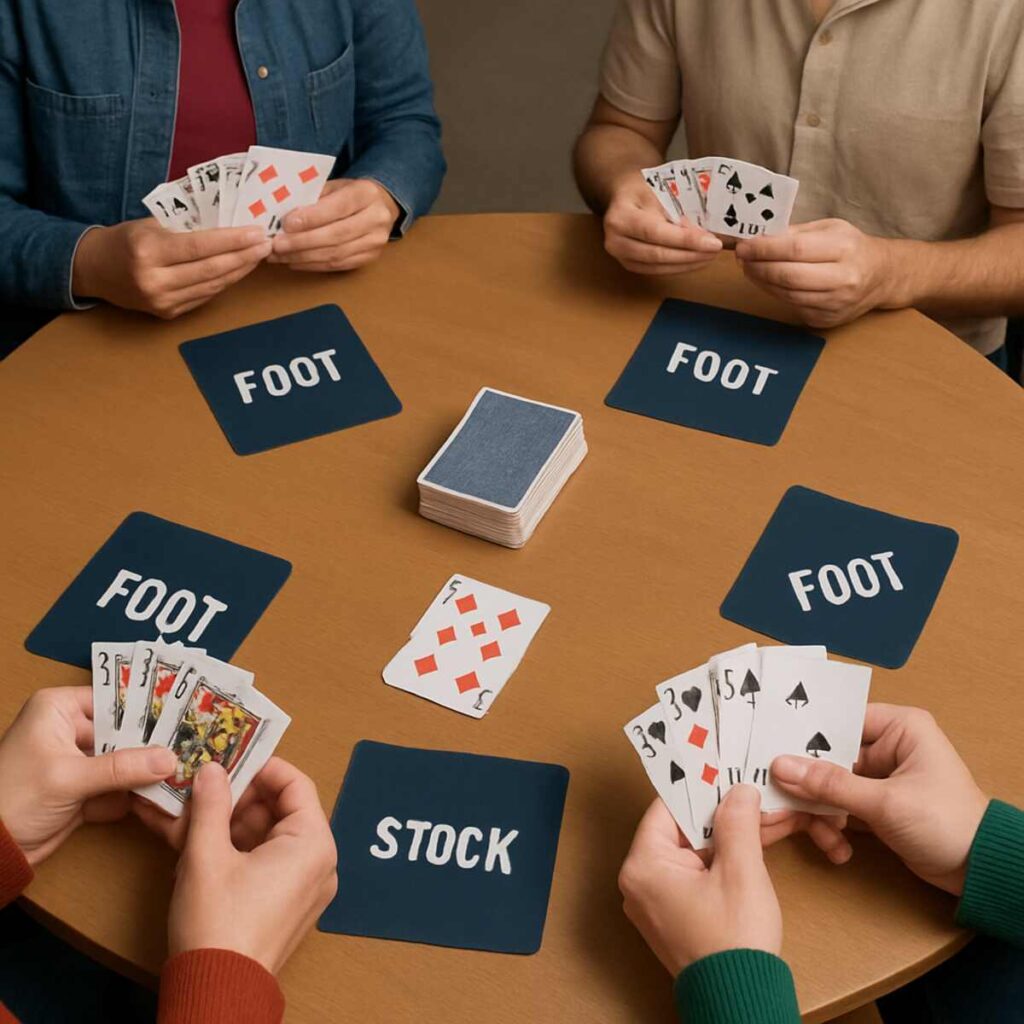
Looking for the perfect card game for your next game night? The Hand and Foot card game is a social favorite, designed for partners to team up and enjoy some friendly competition. Its rules scale beautifully for groups, making it an ideal choice whether you have four people or a whole crowd. To find more, check on Bola169
The game’s memorable twist is that every player has a “Hand” to start with and a hidden “Foot” pile they can only access after their first hand is empty. This game-changing moment keeps every round exciting and full of surprises. This guide will teach you the entire game from scratch, from setup to final scoring, so you’ll be ready to lead your team in a complete round.
What You Need to Play: Gathering Your Cards and Your Team
The first thing you’ll need for Hand and Foot is a lot of cards. The rule is simple: use one more deck than there are players, and be sure to include all the Jokers from each deck.
- 4 players = 5 decks
- 6 players = 7 decks
Your team’s goal is to score the most points by creating “books”—a set of seven cards of the same rank, like seven 8s or seven Kings. Since Hand and Foot is a team game, seating is key. In the common four-player version, partners sit directly across the table from one another. This balances the competition and ensures you can’t see your partner’s hand, making teamwork a fun challenge.
How to Deal for 4 Players, Step-by-Step
With your cards shuffled and teams seated, it’s time to deal. The process is unique but easy once you do it once.
- Each player takes a portion of the shuffled cards and deals one 11-card pile, face-down.
- This pile is the Foot. Pass your newly dealt Foot pile to the player on your left. You’ll receive a Foot from the player on your right. Don’t look at it; just set it aside for now.
- The main dealer then deals a second 11-card pile to every player. This is your Hand.
You’ll start by playing only with the cards in your Hand. The Foot pile is your secret backup; you can pick it up only after you’ve gotten rid of all the cards in your starting Hand.
Before the first turn, everyone picks up their Hand pile. If you have any Red Threes (the 3 of hearts or 3 of diamonds), you must immediately place them face-up on the table and draw the same number of replacement cards from the main pile.
Finally, the dealer places all remaining cards in the center to form the Stock pile (the main draw pile) and turns one card face-up next to it to start the Discard pile. Now the table is set.
The Anatomy of a Turn: Draw, Meld, and Discard
Every player’s turn follows a simple, three-step sequence: 1. Draw, 2. Meld, 3. Discard. Play continues clockwise, starting with the player to the left of the dealer.
At the start of your turn, you always begin by drawing two cards from the top of the Stock pile. After drawing, you have the option to “meld,” which is creating sets of three or more cards of the same rank (like three 6s or four Jacks). If you have a valid meld, you lay it face-up on the table for your team. This is the main way you score points. You can play as many melds as you like during this part of your turn.
To end your turn, you must discard one card from your hand onto the discard pile. The only time you don’t discard is on the final turn when your team “goes out.” For now, just remember the rhythm: draw two, meld if you can, and discard one.
Unlocking Special Cards: Wilds, Red Threes, and Black Threes
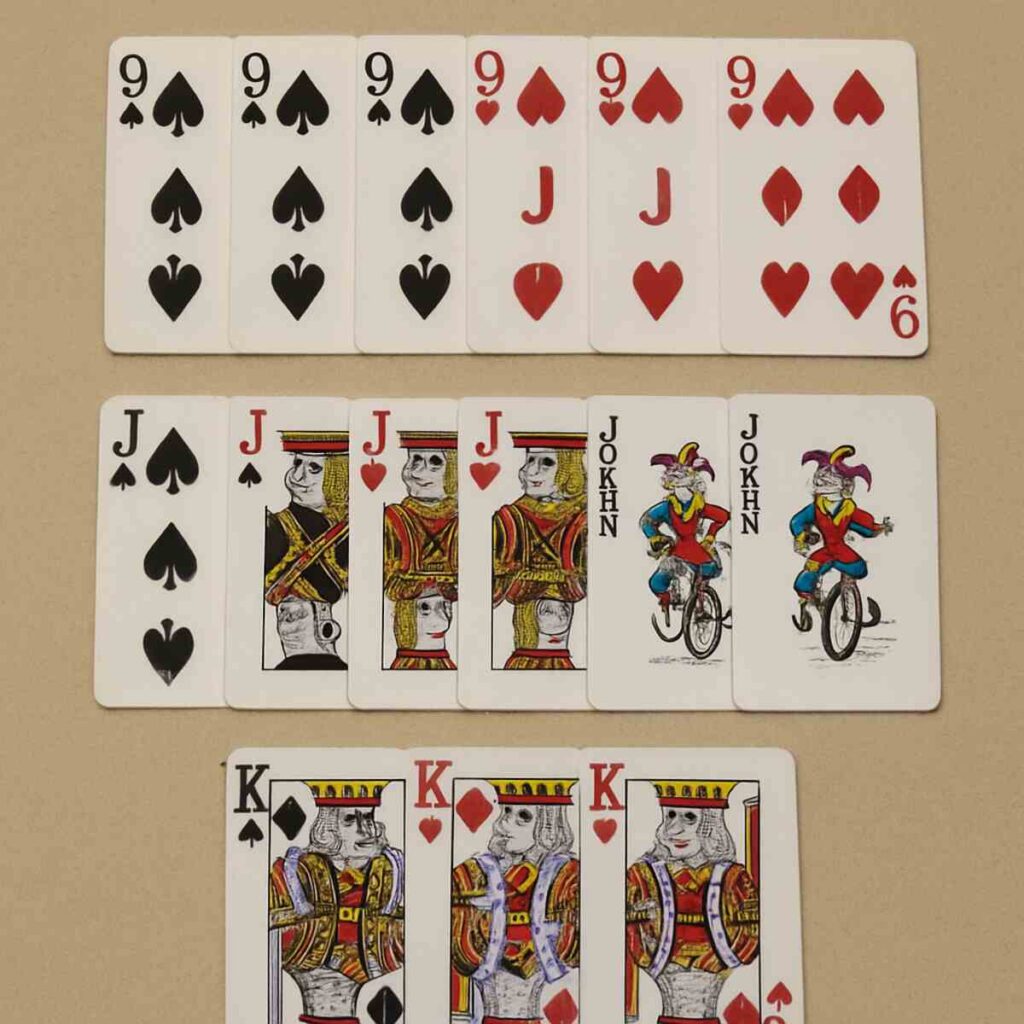
While most cards are straightforward, a few have special jobs. In Hand and Foot, the Jokers and all the 2s are wild cards. They can stand in for any card you need to form a meld. For example, if you have two 9s, you can add a Joker to create a meld of three 9s.
Any meld containing a wild card is considered “dirty.” In contrast, a meld made of only natural cards is called a “clean” meld. This distinction is critical because clean sets are worth more points. A team can have both clean and dirty melds, but you can never add a wild card to an already established clean meld.
Red Threes are pure bonus cards. If you are dealt a Red Three or draw one, you must immediately place it face-up in your team’s meld area and draw a replacement card. They aren’t used in melds but provide a significant point bonus at the end of the round.
Finally, Black Threes serve a defensive purpose. You cannot meld them normally, and they count as penalty points if left in your hand. Because of this, discarding a Black Three is a strategic move that also blocks the next player from picking up the discard pile.
How to Open Melding and Build Your First “Book”
You can’t just lay down your first meld whenever you want; your team must first meet a specific point threshold. To do this, a player must lay down one or more melds from their hand whose cards add up to a minimum point value, typically 50 points for the first round. This is the opening meld, and only one player on a team needs to meet this requirement for both partners to meld freely afterward.
To figure out if your melds meet the minimum, you need to know the card point values. Wild cards (Jokers and 2s) cannot be used in your team’s opening meld.
Here’s how the points break down for opening:
- Aces: 20 points
- 8s through Kings: 10 points
- 4s through 7s: 5 points
- Black 3s: 5 points
For example, three Kings (30 points) isn’t enough to open. However, playing three Kings and three Aces (90 points total) in the same turn would easily meet the 50-point minimum.
Once your team has opened, the goal shifts to building “books,” another name for a Canasta. A book is a meld that has grown to seven cards of the same rank. Books can be clean (seven natural cards) or dirty (containing at least one wild card). Finishing a book locks in a big point bonus and gets you closer to going out.
The Most Powerful Move: How to Pick Up the Discard Pile
Instead of drawing from the stock, you can sometimes pick up the entire discard pile. This is often the most powerful move in a round, but the rules are very specific.
To make this move, two conditions must be met. First, your partnership must have already made its opening meld. Second, you must hold two natural cards (no wilds) in your hand that match the top card of the discard pile. For example, if a Queen is on top, you need two other Queens in your hand. If you meet these requirements, you can take the top card, add your two matching cards to it, play them as a new meld, and then add the rest of the discard pile to your hand.
Taking the pile is a game-changing moment. While it gives opponents information about what you’re collecting, the advantage of gaining so many cards at once almost always makes it worthwhile and is one of the fastest ways to empty your Hand to access your Foot.
How to Access Your “Foot”: The Game’s Big Turning Point
Getting to your “Foot” is the game’s most exciting milestone. The rule is simple: you can only pick up your Foot once you have gotten rid of every single card from your Hand. This is a primary goal, as you cannot end the round until your team is playing from its Foot.
The process is immediate. The moment your Hand is empty, you pick up your Foot pile and your turn continues. It automatically becomes your new hand, and you can immediately use the fresh cards to make new melds or add to your team’s existing ones. Accessing your Foot can give you the exact cards needed to complete books and push your team toward victory.
Ending the Round: The Rules for “Going Out”
Once both you and your partner are playing from your Foot piles, your team can end the round by “going out.” To do so, your team must first meet three conditions.
First, your team must have its required books on the table—typically at least one “clean” book (seven cards, no wilds) and one “dirty” book (seven cards with at least one wild). Second, you must have a way to play or discard every card left in your hand. Most importantly, you must get your partner’s permission.
On your turn, after you draw but before you meld, you must ask your partner, “May I go out?” If they believe the team has enough points on the table to win, they will say “Yes.” If not, they might say “No,” forcing you to continue your turn as usual. Their answer is final for that turn.
If your partner gives the green light, you can play your cards and discard your final one to go out. The round immediately ends, and your team earns a 100-point bonus.
From Cards to Victory: How to Score Your Round
Scoring is a two-step process: add up all the positive points your team earned, then subtract the penalty points for any cards left in your hands.
Here is a complete breakdown of what everything is worth:
- Positive Points (Bonuses)
- Going Out First: +100 points
- Completed Clean Book (7 natural cards): +500 points
- Completed Dirty Book (contains wild cards): +300 points
- Each Red 3 on the table: +100 points
- Negative Points (Penalties for Cards Left in Hand)
- Each Black 3: -100 points
- Jokers, 2s (Wilds), and Aces: -20 points each
- 8s through Kings: -10 points each
- 4s through 7s: -5 points each
To get your team’s final score, add your book values, the “going out” bonus, and your Red 3s. From that total, subtract the value of all cards remaining in both your and your partner’s hands. To make this easier, consider using a printable Hand and Foot scoring sheet.
Three Simple Strategies to Win Your First Game
A little basic strategy will make your team a true contender. The most powerful cards in your hand are the wilds (Jokers and 2s). While it’s tempting to use them early, try to be patient. Your wilds are more valuable when used to complete a high-scoring book or to make a game-winning play.
Success hinges on cooperation. Always pay attention to the melds your partner has started. If they have four 9s and you draw another 9, your best move is almost always to add it to their meld. Combining efforts allows your team to complete valuable books much faster.
Finally, think carefully about what you discard. If you notice the opposing team is collecting Kings, avoid giving them another one. An even stronger defensive move is to discard a Black Three if the discard pile is loaded with useful cards, as this completely blocks the next player from picking it up.
Is This Like Canasta? Key Differences from Similar Games
If creating melds feels familiar, you might be thinking of Canasta. The biggest difference is right in the name: Classic Canasta uses a single hand, but Hand and Foot gives each player a second, hidden pile—the “Foot.” This adds a unique layer of suspense.
Another key difference is the draw. In Hand and Foot, you draw two cards per turn, whereas most Canasta variations have you draw only one. This speeds up the game, helping you build melds and get into your Foot faster.
Other related games, like Samba, introduce melds of sequences (like a 4-5-6 of Hearts), which aren’t part of Hand and Foot. Its focus on matching sets gives it a straightforward appeal that’s easier for new players to learn.
How to Play With 2 or 6 Players: Simple Rule Adjustments
While Hand and Foot shines with four players, its rules adapt easily. For a two-player duel, use just three decks of cards and play individually. The goal remains the same, but the strategy shifts to a more competitive, one-on-one game.
For six people, add one more deck for a total of seven and form three teams of two, with partners sitting across from each other. This creates a lively table where partnership is even more crucial.
Ultimately, the heart of the game never changes. You’ll still draw two cards, meld your sets, and race to get into your Foot. These adjustments simply ensure the game stays balanced and fun for everyone.
You’re Ready to Play: Grab Your Cards and Have Fun
You now have the complete playbook for Hand and Foot: dealing the two hands, making an opening meld, building books with a partner, and racing to play your Foot to go out.
You’ll quickly find that Hand and Foot is as much about social fun as it is about scoring points. The real magic happens when you and your teammate work together, strategizing melds and celebrating each completed book. It’s this spirit of teamwork that makes it such a beloved card game for family and friends.
The best way to make the rules stick is to play a round. Gather your crew, shuffle those decks, and deal your first game. Your next fun-filled game night awaits.