


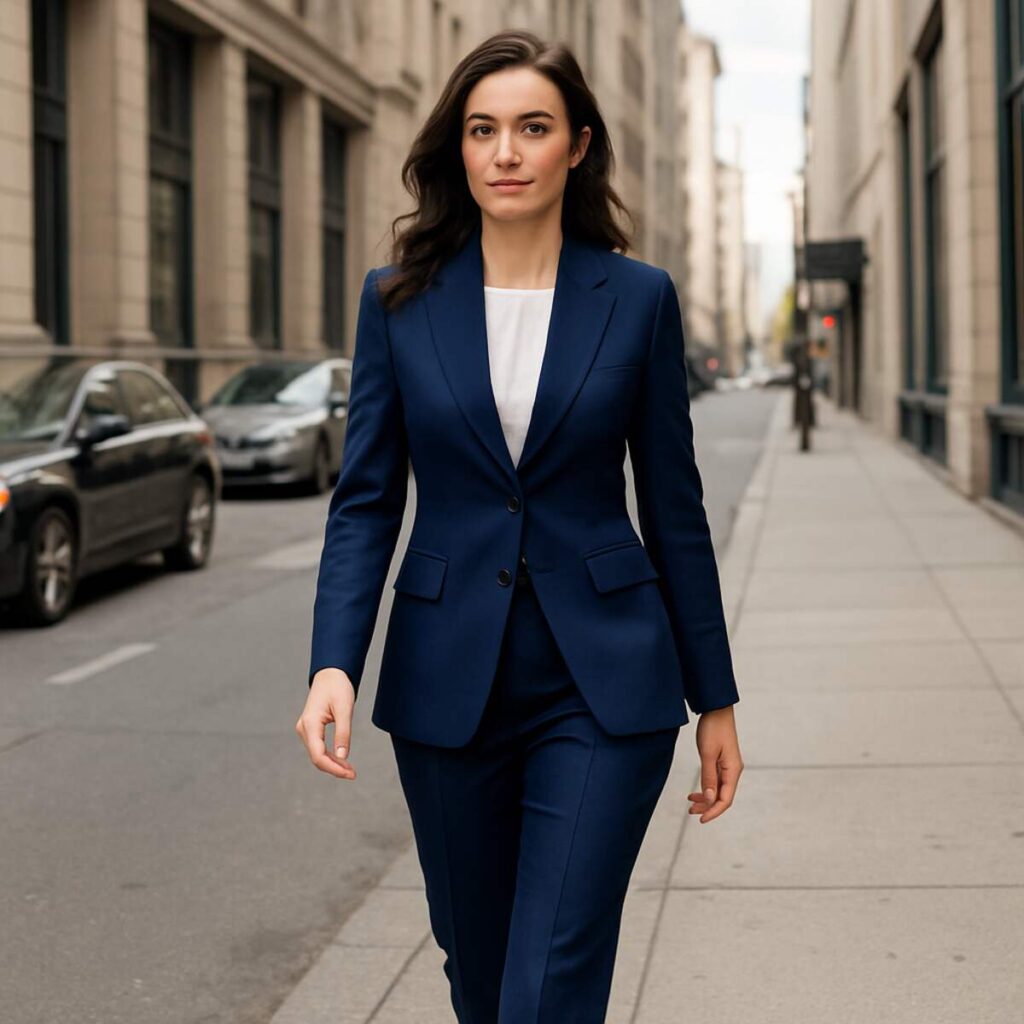
The world of fashion is ever-evolving, but amidst the fleeting trends and fast-fashion fads, one category remains an unwavering symbol of elegance, power, and sophistication: Luxury Women’s Tailoring. Historically, the realm of high-end tailoring was exclusively a boys’ club, leaving women to navigate ready-to-wear options that rarely accounted for the nuances of the female form. Today, however, tailored women’s clothing has experienced a magnificent renaissance. Choose the best Luxury Women’s Tailoring.
From the boardroom to the red carpet, perfectly fitted garments speak volumes before you even say a word. Whether you are building a professional capsule wardrobe or seeking that one transformative, confidence-boosting garment, understanding the intricacies of luxury women’s tailoring is your key to sartorial mastery.
In this comprehensive guide, we will explore everything from the rich history of tailoring and the intricacies of high-end craftsmanship to practical advice on achieving the perfect fit. Welcome to the masterclass in timeless style.
The Evolution of the Female Silhouette in Tailoring
To truly appreciate modern custom women’s suits, one must look back at the origins of this craft. For centuries, traditional tailoring was focused almost entirely on menswear. Women’s garments were crafted by dressmakers, focusing on draping and softer constructions rather than the rigid, structured techniques of the tailor.
Embracing the Savile Row Heritage for Women
Savile Row, a street in Mayfair, London, is globally renowned as the golden mile of tailoring. For generations, its legendary houses crafted bespoke suits for kings, presidents, and Hollywood icons—almost exclusively male. However, the last few decades have seen a profound shift. We are now seeing the integration of Savile Row heritage for women, where historic tailoring houses are finally adapting their centuries-old techniques to suit the female body.
This heritage brings a level of structure and architectural brilliance to womenswear that was previously missing. Master tailors are taking the robust inner construction, the precise cutting techniques, and the flawless finishing of traditional menswear and reshaping them to celebrate, rather than obscure, the female form. This blend of masculine structure and feminine elegance is the very heartbeat of modern luxury tailoring.
Understanding Customization: Deciphering the Tailoring Tiers
When stepping into the world of luxury tailoring, the terminology can be daunting. The most common point of confusion lies in understanding the difference between bespoke, made-to-measure, and off-the-rack alterations. To make informed investments, you must know exactly what you are paying for.
Bespoke vs Made-to-Measure Women’s Blazers
If you are looking to invest in a foundational piece, you will likely find yourself weighing the pros and cons of bespoke vs made-to-measure women’s blazers. While both offer a superior fit to ready-to-wear, the processes are vastly different.
Made-to-Measure (MTM):
- The Process: MTM starts with a pre-existing pattern (a block) that is closest to your size. The tailor will take a set of your measurements and alter this digital or physical pattern to accommodate your body.
- The Construction: Machine sewing plays a larger role in MTM, though hand-finishing is often present in luxury tiers.
- The Fittings: Usually requires only one or two fittings.
- Best For: Women with relatively standard proportions who want a highly personalized fabric and a superior fit without the time commitment of true bespoke.
Bespoke:
- The Process: The pinnacle of luxury women’s tailoring. A completely unique paper pattern is drafted from scratch based on 30+ precise measurements of your body, accounting for your posture, shoulder slope, and unique curves.
- The Construction: Heavily reliant on hand-sewing. The garment is literally built around you.
- The Fittings: Requires multiple fittings (usually a minimum of three: the baste fitting, the forward fitting, and the final fitting).
- Best For: Those seeking absolute perfection, ultimate customization, and a garment that is essentially a second skin.
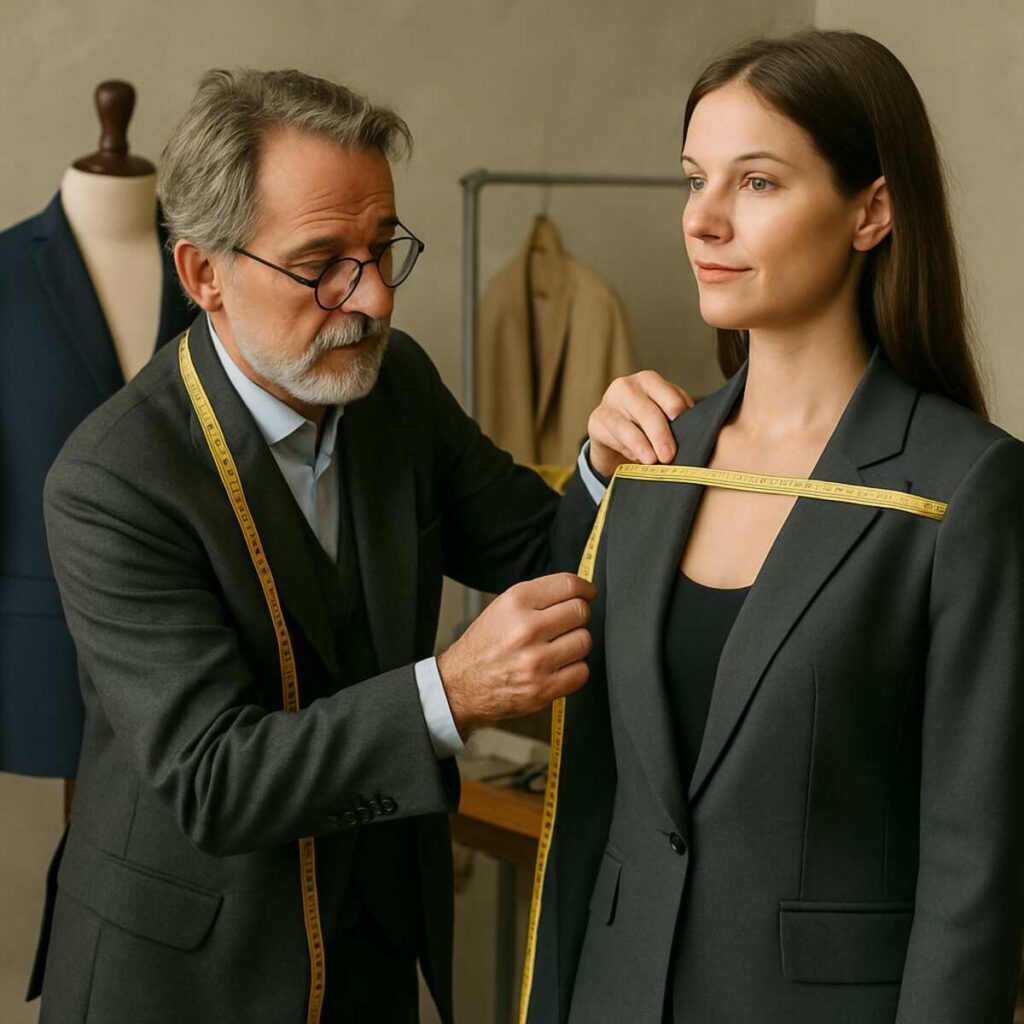
Finding Your Sartorial Partner
Investing in high-end tailoring is an intimate and collaborative process. Your tailor is the architect of your wardrobe, so choosing the right one is paramount.
How to Find a Master Tailor for Women
Finding a tailor who truly understands womenswear is different from finding a great menswear tailor. The female body involves complex curves, varying bust lines, and different proportional balances that require a specific skill set. Here is how to find a master tailor for women:
- Examine Their Portfolio: Look for tailors who prominently feature women in their lookbooks. If their portfolio is 99% men, they may try to fit you into a scaled-down men’s block, resulting in a boxy, unflattering silhouette.
- Ask About Their Pattern Drafting: A true master tailor will be transparent about their process. Ask if they draft unique patterns for women or if they adapt men’s blocks.
- Check the Details: Look at the lapel roll, the shoulder expression, and how the fabric drapes over the hips on their previous clients. These areas are notoriously difficult to master on women’s suits.
- The Consultation Connection: Your tailor should ask questions about your lifestyle, your profession, and how you want to feel in the garment. Communication is just as crucial as cutting.
Flattering Every Figure: The Art of Fit
The ultimate goal of tailoring is to enhance the wearer’s natural geometry. Fit is not just about a garment being tight or loose; it is about proportion, balance, and visual harmony.
Achieving the Perfect Feminine Suit Silhouette
Achieving the perfect feminine suit silhouette requires a delicate balancing act. A masterful tailor will use structural elements to highlight your best features.
- The Shoulders: The shoulder line dictates the attitude of the suit. A roped shoulder gives a powerful, authoritative look, while a soft, unpadded shoulder (Spalla Camicia) offers a relaxed, Neapolitan elegance.
- The Waist Suppression: Unlike men’s suits, which often feature a slight taper, women’s suits typically require more aggressive waist suppression (nipping in at the waist) via strategically placed front darts and curved side seams to highlight the natural hourglass, pear, or athletic shape.
- The Length: The length of a jacket can elongate the legs or balance a long torso. A jacket should generally end where your bottom curves under, but cropped styles or longer tunic lengths can be manipulated to suit your unique proportions.
Tailoring Solutions for Petite Female Frames
For women under 5’4″, finding tailored clothing can be uniquely frustrating, as standard blocks often overwhelm the frame. Expert tailoring solutions for petite female frames focus entirely on vertical illusions and precise micro-proportions:
- Higher Armholes: A high armhole creates the illusion of a longer torso and prevents the entire jacket from lifting when you move your arms.
- Narrower Lapels: Wide lapels can swallow a petite frame. A narrower, elongated lapel (especially a peak lapel) draws the eye upward and elongates the body.
- Shorter Jacket Lengths: Raising the hem of the jacket by just an inch can dramatically lengthen the appearance of the legs.
- Proper Trouser Breaks: Avoid puddling fabric at the ankles. A slight break or a clean, no-break hem ensures the leg line remains uninterrupted.
A Masterclass in Bottoms: The Custom Trouser
While jackets often get all the glory, a perfectly fitted pair of trousers is a transformative wardrobe staple. Ready-to-wear trousers often gap at the waist, pull at the hips, or sag in the seat. Custom tailoring solves these issues entirely.
Comprehensive Guide to Measuring for Custom Trousers
If you are ordering made-to-measure online or simply want to understand what your tailor is doing, a basic guide to measuring for custom trousers is essential.
- The Natural Waist: Bend to the side; the crease that forms is your natural waist. Wrap the tape measure around this point, keeping it snug but not restrictive. (Note: High-waisted trousers sit here, while mid-rise sits lower, near the navel).
- The Hips/Seat: Measure around the absolute fullest part of your hips and buttocks. Ensure the tape is parallel to the floor. This measurement is crucial to prevent pocket-flaring.
- The Thigh: Measure the circumference of your thigh just below the crotch. This determines the drape and comfort of the upper leg.
- The Rise (Front and Back): The front rise is measured from the crotch seam to the top of the front waistband. The back rise is measured from the crotch seam to the top of the back waistband. Women typically require a significantly longer back rise than men to accommodate curves and ensure the trousers don’t pull down when seated.
- The Inseam: Measure from the crotch seam down the inner leg to the desired hem length. This will depend heavily on the shoes you plan to wear with the trousers.
The Anatomy of a Masterpiece: Crafting Luxury
What makes a custom suit cost thousands of dollars, while a fast-fashion blazer costs fifty? The answer lies beneath the surface. True luxury tailoring is as beautiful on the inside as it is on the outside.
Exploring the Inner Construction of Designer Ladies’ Jackets
The inner construction of designer ladies’ jackets is an architectural marvel. A cheap blazer uses “fusible” (a type of glue) to attach a stiffening fabric to the wool, making it look crisp on the hanger. However, over time and after dry cleaning, this glue breaks down, causing the fabric to bubble and stiffen awkwardly.
Luxury bespoke garments eschew glue entirely. Instead, they utilize a floating canvas.
The Hand-Stitched Canvas in Women’s Coats
The soul of a bespoke jacket is the canvas. Usually made of a blend of horsehair, wool, and cotton, this canvas is cut to match the shape of the jacket.
The hand-stitched canvas in women’s coats and blazers is painstakingly sewn inside the front panels using thousands of invisible, flexible stitches (called pad stitching). Because it is sewn, not glued, the canvas “floats.” This allows the jacket to drape naturally, breathe properly, and—most importantly—mold to the exact shape of your body over time. A canvas jacket actually fits better the more you wear it, acting as a sartorial memory of your silhouette.
Unveiling High-End Sartorial Craftsmanship Techniques
Beyond the canvas, true bespoke garments utilize high-end sartorial craftsmanship techniques that machines simply cannot replicate:
- Hand-Sewn Armholes: Attaching the sleeve to the shoulder by hand allows the tailor to ease in extra fabric, providing the wearer with an incredible range of motion that a machine-sewn armhole cannot achieve.
- The Collar Attachment: The collar is the anchor of the jacket. Hand-sewing the undercollar ensures it hugs the back of the neck perfectly, without any unsightly gaps.
- Pattern Matching: If your suit is plaid, checked, or striped, a master tailor ensures the pattern matches perfectly across every seam, pocket, and lapel. This requires cutting significantly more fabric and demands absolute mathematical precision.
What Defines High-End Garment Finishing
The final touches of a garment are its visual signatures of luxury. What defines high-end garment finishing is a fanatical attention to detail:
- Working Buttonholes (Surgeon’s Cuffs): The buttons on the sleeve of a luxury jacket actually unbutton. This detail stems from the days when surgeons needed to roll up their sleeves to operate without removing their jackets. Today, leaving the last button undone is a subtle nod to the bespoke nature of the garment.
- Horn or Mother of Pearl Buttons: Plastic buttons have no place in luxury tailoring. Genuine animal horn, corozo nut, or mother of pearl are used for their natural luster and durability.
- Pick Stitching (AMF Stitching): Look closely at the edge of the lapel and pockets. You will see a subtle, slightly irregular stitch running along the edge. When done by hand, pick stitching keeps the edges of the garment flat and crisp while adding a beautiful, artisanal texture.
- Bemberg Cupro or Silk Linings: High-end jackets are lined with breathable, static-resistant materials like Bemberg (a natural cotton byproduct) or pure silk, never cheap, sweat-inducing polyester.
Fabric Matters: Selecting the Perfect Foundation
Even the best tailor in the world cannot make a magnificent suit out of terrible fabric. The cloth you choose dictates the drape, durability, and seasonality of your garment.
Premium Italian Wool Versus Silk-Blend Fabrics
When visiting a tailor, you will be presented with heavy books of fabric swatches (bunches). Two of the most sought-after categories for women’s luxury suiting are pure wools and silk blends. Understanding premium Italian wool versus silk-blend fabrics is key to making the right choice for your lifestyle.
Premium Italian Wool: Italian mills (such as Loro Piana, Vitale Barberis Canonico, and Zegna) are famous for producing the finest wools in the world.
- The Super Numbers: You will often see wools graded as Super 110s, Super 130s, Super 150s, etc. This refers to the fineness of the individual wool fiber. Higher numbers mean softer, silkier wool. However, higher numbers also mean the fabric is more delicate and wrinkles faster. For a daily workhorse suit, a Super 110s or 120s is ideal. For a special occasion suit, a Super 150s offers unparalleled luxury.
- Characteristics: Pure wool is naturally breathable, wrinkle-resistant, odor-resistant, and drapes beautifully. Worsted wool is perfect for business, while flannel wool is excellent for winter warmth.
Silk-Blend Fabrics: Often blended with wool, cashmere, or linen, silk adds an entirely different dimension to tailoring.
- Characteristics: Silk introduces a subtle, luxurious sheen and an incredibly soft hand-feel. A wool-silk blend is much lighter than pure wool, making it fantastic for spring and summer tailoring or evening wear.
- Considerations: Silk is less resilient than wool. It has a tendency to crease, and it doesn’t have the natural stretch or “memory” of wool. Therefore, silk blends are often reserved for statement blazers, cocktail suits, or garments not meant for rigorous daily wear.
Curating Your Collection: Essential Garments
When building a tailored wardrobe, it is wise to start with foundational pillars before moving on to eclectic statement pieces. Carefully chosen items will serve you for decades.
Investment Pieces for Professional Female Wardrobes
When curating investment pieces for professional female wardrobes, versatility and longevity are the primary goals.
- The Three-Piece Navy Suit: Navy is less harsh than black and flatters almost all skin tones. A three-piece suit (jacket, trousers, and a tailored waistcoat) offers supreme versatility. Wear all three for board meetings, pair the waistcoat and trousers for a stylish business-casual look, or wear the blazer with jeans on the weekend.
- The Perfect Camel Hair or Cashmere Overcoat: Tailoring extends beyond suits. A bespoke winter overcoat, cut to fit seamlessly over your blazers without bunching, is the ultimate statement of winter elegance.
- The Textured Tweed or Bouclé Blazer: Perfect for less formal days, a structured blazer in a textured fabric adds depth to your wardrobe. It pairs beautifully with tailored trousers, silk skirts, or dark denim.
Evening Elegance: Contemporary Feminine Tuxedo Styling Tips
The tuxedo (or Le Smoking, as popularized by Yves Saint Laurent in the 1960s) remains one of the most sensual, powerful, and elegant evening wear options for a woman. It is the ultimate alternative to the traditional evening gown.
When commissioning a tuxedo, pay attention to the lapel facings—usually finished in sleek silk satin or ribbed silk grosgrain. To master the look, follow these contemporary feminine tuxedo styling tips:
- The Bare Skin Approach: For a boldly modern, highly sensual evening look, wear the tuxedo jacket securely fastened with nothing underneath, relying on the impeccable cut of the jacket and double-sided fashion tape for security.
- The Silk Camisole: For a softer, more romantic approach, pair a sharp, structured peak-lapel tuxedo with a delicate lace-trimmed silk camisole. The contrast between masculine structure and feminine delicacy is visually striking.
- Footwear Pairings: A feminine tuxedo accommodates a variety of footwear. A classic pointed-toe stiletto elongates the leg line, while a velvet smoking slipper or patent leather loafer leans into an effortlessly chic, androgynous aesthetic.
- Jewelry: Keep it structural and minimal. A statement watch, diamond studs, or a simple lariat necklace complements the stark elegance of a tuxedo without competing with it.
The Future of Fashion: Ethics, Longevity, and Care
In an era increasingly defined by the devastating environmental impacts of fast fashion, bespoke tailoring stands as a beacon of responsible consumption.
Sustainability in Luxury Couture Production
The philosophy of tailoring is inherently aligned with eco-conscious practices. Sustainability in luxury couture production is not merely a buzzword; it is baked into the very DNA of the craft.
- Slow Fashion: A bespoke suit takes weeks, sometimes months, to create. This “slow fashion” model completely subverts the overproduction crisis plaguing the retail industry. Garments are made only when ordered, meaning there is zero unsold inventory sent to landfills.
- Natural Materials: Luxury tailoring relies almost exclusively on natural, biodegradable fibers like wool, silk, cotton, linen, and horn, shunning the microplastic-shedding synthetic fabrics that dominate ready-to-wear.
- Generational Lifespan: A glued, fast-fashion blazer might last a season before losing its shape. A canvas-constructed bespoke suit, made from premium wool, is designed to last a lifetime. Many bespoke garments are passed down through generations or easily altered if the wearer’s weight fluctuates.
Maintaining Quality of Handmade Designer Apparel
To ensure your investment truly lasts a lifetime, proper aftercare is non-negotiable. Maintaining quality of handmade designer apparel requires breaking some common habits.
- Limit Dry Cleaning: This is the most important rule of tailoring. Dry cleaning involves harsh chemicals that strip wool of its natural oils, causing it to become brittle and shiny. You should only dry clean a suit once or twice a year, or if it has a physical stain.
- The Power of the Brush: To clean your suit daily, invest in a high-quality natural bristle garment brush. After taking off your suit, briskly brush the fabric in downward strokes. This removes surface dust, dirt, and food particles before they settle into the fibers.
- Let It Rest: Wool is a living, breathing fiber that needs time to recover its shape. Never wear the same suit two days in a row. Let it hang in a well-ventilated area for 24 to 48 hours after wearing.
- Use the Right Hangers: Never use wire or thin plastic hangers; they will ruin the shoulder structure of your bespoke jacket. Always use a thick, contoured wooden hanger designed specifically for tailored jackets, which mimics the slope of human shoulders.
- Steam, Don’t Iron: If your suit gets wrinkled, use a handheld garment steamer. Never press a hot iron directly onto wool, as it will crush the fibers and leave a permanent, ugly shine.
The Timeless Power of the Tailored Woman
Stepping into a garment that has been meticulously drafted, cut, and stitched exclusively for your body is a transformative experience. Luxury Women’s Tailoring is far more than just the sum of its parts—more than the hand-stitched canvas, the premium Italian wools, and the exacting measurements. It is a profound assertion of self-worth.
For decades, women have compromised, settling for garments that sort-of fit, rolling up sleeves, belting oversized waists, and accepting the discomfort of mass-produced fashion. Custom tailoring eliminates compromise entirely. It celebrates your exact proportions, acknowledges your unique style, and provides a sartorial armor that allows you to face the world with unshakeable confidence.
Whether you are investing in a razor-sharp tuxedo for evening galas, a commanding navy suit for the boardroom, or the perfect pair of bespoke trousers, remember that high-end tailoring is not an expense; it is an investment in yourself, your confidence, and a sustainable, elegant future. The perfect fit is no longer an illusion—it is waiting for you at the tailor’s cutting table.