



Ever been at a party and heard a group of people suddenly start shouting “Trading Four! Four! Four!” over each other? You might have seen someone frantically ring a bell and slam their cards down, ending the round in a burst of laughter and groans. Chances are, you’ve just witnessed a classic pit card game in action. It looks like pure chaos, but that energy is exactly what makes it one of the most exciting party games you’ll ever play. To find more, check on KAPTEN189
That noisy scene isn’t a sign of a game gone wrong; it’s the game working perfectly. Unlike games where you patiently wait for your turn, Pit is one of the original fast-paced trading card games where everyone plays at once. The core idea is surprisingly simple: trade your cards as fast as you can to collect a full set of one commodity, like Wheat or Corn. The legendary Parker Brothers Pit game was designed from the ground up for exactly this kind of frantic, social fun.
If you’ve been a confused bystander, this guide is your ticket into the trading pit. It breaks down the simple steps to get you set up, shouting trades, and ringing that bell to claim victory in your very first round. Forget long, complicated rulebooks. In just a few minutes, you’ll go from watching the chaos to creating it—and you’ll be ready to teach your friends.
What’s the Goal? How to “Corner the Market” and Win a Round
Unlike many card games where you take turns, the objective of the Pit game is beautifully simple and happens all at once: be the first player to collect all nine matching cards in your hand. There’s no complex point-counting during the round or worrying about special card combinations. Your focus is singular: gather a complete set before anyone else does.
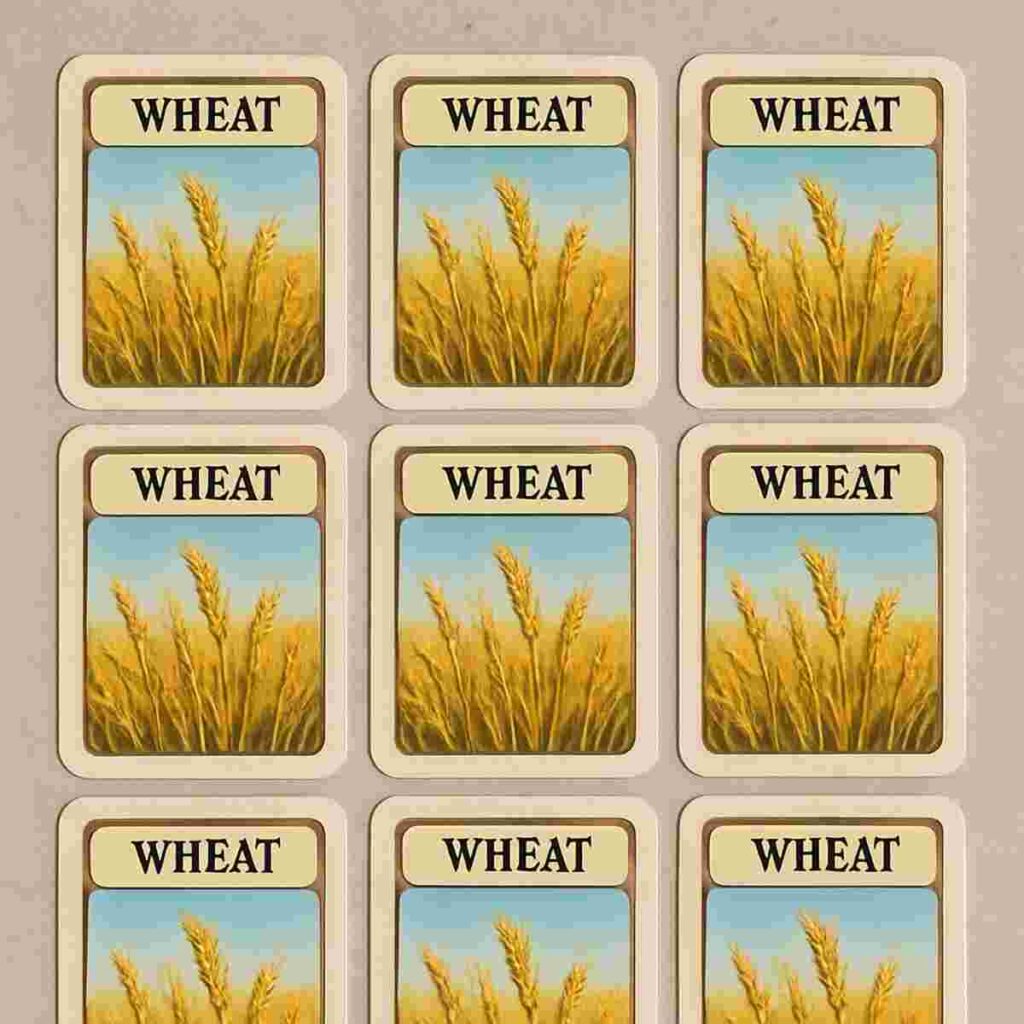
In this fast-paced commodity trading card game, each type of card—like Wheat, Corn, or Coffee—is called a commodity. Your mission is to collect one complete set. When you finally hold all nine cards of a single type, you have successfully “Cornered the Market.” It’s a fancy term for a simple idea: getting all nine Wheats, or all nine Oats, and leaving none for anyone else.
As soon as your hand contains a full set of one commodity, you’ve won the round! It’s the signal to stop trading, ring the bell, and claim your victory. Before you can corner your first market, you need to get the cards in your hands. Here’s how to set up your game.
Game Night Setup: What You Need and How to Deal for Any Group Size
Getting started with the Pit card game is quick, but it has one crucial setup rule that makes the game work. Before you can start shouting and trading, you need to prepare the deck based on how many people are playing. Open the box, and you’ll find the game’s bell and several sets of commodity cards—these are your “suits” like Wheat, Barley, and Corn.
The single most important rule for Pit game setup is this: the number of commodity suits you use must be equal to the number of players. This ensures there is exactly one complete set available for each person playing, making it possible for someone to corner the market. Simply count your players, then select that many full commodity suits to create your playing deck.
To make it easy, here’s a quick guide:
- 3 Players: Use 3 different commodity suits (27 cards total)
- 4 Players: Use 4 different commodity suits (36 cards total)
- 5 Players: Use 5 different commodity suits (45 cards total)
- 6 Players: Use 6 different commodity suits (54 cards total)
- And so on, up to the maximum number of players your deck supports.
Once you have the right number of suits, set the unused commodity cards back in the box. Shuffle the selected deck thoroughly and deal all the cards out, one at a time, as evenly as possible among the players. Don’t worry if some players end up with one more card than others—this small imbalance disappears instantly once the frantic trading begins. Now that everyone has a hand of cards, you’re ready for the main event.
The Heart of the Game: How to Trade, Shout, and Swap Your Cards
Forget taking turns. The moment the dealer says “The pit is open!”, a free-for-all begins. This is where Pit earns its reputation as one of the best fast-paced trading card games. Everyone trades with everyone else, all at the same time, until one person wins the round. It might sound chaotic—and it is!—but the trading process follows a few simple, crucial rules.
The first and most important rule is that you can only trade a block of cards that are all the same commodity. You can’t mix a Wheat card with a Barley card in the same trade. If you want to trade two cards, they must both be Corn or both be Oats, and so on. You can trade a block of one, two, three, or four cards at a time. Deciding which cards to get rid of and which commodity to collect is your first big decision.
Once you’ve chosen a block of cards to trade, the action begins. Here’s how to play the Pit card game for beginners, broken down into four steps:
- Pick Your Cards: Choose between one and four cards of the same type (e.g., three ‘Barley’ cards) that you want to trade away.
- Shout the Number: Clearly and repeatedly shout the number of cards you are offering. For a three-card block, you would yell, “Trading Three! Three! Three!”
- Find a Partner: Listen for another player who is also shouting the same number as you. If you’re yelling “Three!”, you need to find someone else yelling “Three!”.
- Swap Blindly: Once you’ve found a match, quickly swap your block of cards for theirs. The trade is blind—you hand your cards over face-down, and they do the same. You don’t know what you’re getting until you’ve put the new cards in your hand!
For instance, imagine your goal is to collect all nine ‘Wheat’ cards. You look at your hand and see you have two ‘Rye’ cards you don’t need. You would hold those two cards out and start shouting, “Trading Two! Two! Two!” until another player shouting “Two!” makes eye contact. You’d quickly swap your two Rye cards for their two mystery cards, hoping they turn out to be the Wheat you need.
You’ll repeat this process of shouting and swapping as fast as you can. The goal is to offload the commodities you don’t want while gathering the ones you do. This frantic exchange continues until one player successfully collects all nine cards of a single type and is ready to yell, “Corner!”
“CORNER!” — How to Win the Round and Score Your Points
So, you’ve frantically traded your way to a complete set of nine matching cards. What now? This is the moment all that shouting pays off. The instant you secure that ninth card, you must grab the bell at the center of the table and ring it loudly. As you ring it, slap your cards face-up on the table for everyone to see and declare, “Corner on Wheat!” (or whatever commodity you collected). This action immediately stops the round—all other trading must cease.
Once you’ve proven you have a valid corner by showing your nine matching cards, it’s time to figure out your score. This is the core of pit card game scoring. Each commodity has a different point value, which is clearly printed on the cards themselves. Simply look at the number on one of your winning cards to find your score for the round. For example, if you successfully cornered the market on Wheat, and the Wheat cards are valued at 100, you earn 100 points.
What about everyone else? For that round, they score a big, fat zero. It doesn’t matter how close they were to finishing their own set; only the winner who rang the bell earns points. This is a key part of the Parker Brothers Pit game instructions: speed is everything. The first person to corner the market takes all the glory and all the points for that round.
After the winner’s score is written down, the excitement starts all over again. Gather all the cards, shuffle them thoroughly, deal out new hands, and get ready for the dealer to announce that the pit is open once more. Each round is a fresh chance for anyone to win, adding up points until one player reaches the game’s overall winning score.
Playing a Full Game: From the First Trade to the Final Winner
Winning a single round is a thrill, but the real objective of the Pit game is to be the first player to reach a total of 500 points. Think of each round as a single sprint in a longer marathon. You’ll play round after round, with players accumulating points each time they successfully corner a market. The first person whose total score hits that 500-point finish line is declared the ultimate winner of the game.
To keep the game moving smoothly, a little bit of procedure helps between rounds. The player who just won the round and earned the points takes on the responsibility of being the next dealer. They should gather up all the cards from the table, give them a good shuffle to mix up the commodities, and deal out fresh hands to every player. This simple rule from the pit card game instructions ensures everyone gets a turn to control the start of a round.
This cycle of frantic trading, scoring points, and passing the deal continues until one player reigns supreme. Once you’re comfortable with this basic flow, you might be ready to add a little more chaos to the mix. For those who want an extra layer of strategy and risk, it’s time to introduce two of the most exciting cards in the deck: the Bull and the Bear.
Adding a Twist: What Are the Bull and Bear Cards?
If you’re ready to add a dose of delightful chaos to your game, it’s time to shuffle in the Bull and Bear. These two special cards, often included in pit deluxe edition features, completely change the dynamic of trading. They don’t belong to any commodity set, and their entire purpose is to either give you a huge advantage or a painful penalty. Understanding what is the bull and bear in pit is key to moving from a casual player to a savvy trader.
Think of the Bull as the ultimate wild card, just like a Joker in other card games. It’s your best friend in the pit. If you have the Bull in your hand, you can declare it to be any commodity you need. For example, if you have eight Wheat cards and the Bull, you can slam your hand down and ring the bell—the Bull completes your set and wins you the round! Getting this card in a trade is a moment of pure luck that can instantly put you on the path to victory.
The Bear, however, is the exact opposite. It’s a penalty card you want to get rid of as fast as possible. According to the pit card game rules, anyone holding the Bear card when a round ends—even the player who won the round—must subtract 20 points from their score. Suddenly, a winning hand can turn into a net loss if you weren’t careful enough to offload this dangerous card before someone else cornered the market.
This raises the obvious question: how do you get rid of a card nobody wants? You can’t shout “Trading one!” with the Bear, as no one would knowingly take it. The only way to pass it on is to hide it. To do this, you must include it in a trade of two, three, or four cards. For instance, if you have the Bear and two Barley cards, you’d frantically shout “Trading three! Three!” and hope an unsuspecting player swaps with you. This sneaky maneuver is a crucial survival tactic when the Bear is in play, adding a thrilling layer of risk to every single trade.
Beginner’s Strategy: How to Trade Smarter, Not Just Faster
While the frantic shouting of Pit might seem like pure chaos, a little bit of smart thinking can give you a huge advantage. Winning isn’t just about trading quickly; it’s about trading with a purpose. Moving beyond random swaps is the first step in learning how to win the game Pit, turning you from a frantic participant into a focused trader.
A few simple tips for the Pit card game can make all the difference. Instead of getting overwhelmed by the noise, focus on your own hand and listen to the “market” around you. The best pit game strategy for cornering a market often boils down to making a quick decision and then gathering information as you play.
Ready to improve your odds? Keep these three principles in mind during the next round:
- Commit Early and Stick With It. At the start of the round, look at your hand. Whichever commodity you have the most of—even if it’s just three or four cards—is your target. If you have four Wheat and three Barley, your goal is now Wheat. Trade away everything else as fast as you can.
- Trade to Get Unstuck. If you end up with a single, untradable card (like one lonely Oats), you have a problem. Your best move is to actively trade for more Oats. If someone is shouting “Trading Two!,” make that swap. You might get another Oat, giving you a pair you can now trade away.
- Listen to the Shouts. The noise is actually valuable information. If you hear several people shouting “Trading Three!”, you know there’s a good chance you can complete a three-card swap quickly. If one player is desperately shouting “One! One!”, you know what they’re trying to get rid of (and can avoid taking it). Listen to what’s in demand.
Pit vs. Spoons: Why Are They So Different?
If you’ve played other fast-paced card games, your mind might jump to Spoons. Both games can end with a frantic grab—for a spoon or for the bell—but how you get to that moment is worlds apart. While Spoons feels like a race on a single-lane track, Pit is a free-for-all demolition derby where everyone is shouting and swapping parts at the same time. The shared speed is just a surface-level similarity.
The biggest difference in the pit card game vs spoons debate is the concept of turns. Spoons has a clear, structured order: you take a card from the person next to you and pass one along. It’s fast, but it’s sequential. Pit throws that structure out the window. There are no turns. Everyone shouts and trades with anyone else, all at once, creating the game’s signature chaotic energy that you simply don’t find in turn-based games.
Finally, the goal itself dictates the game’s feel. In Spoons, you only need to collect four of a kind. In the commodity trading card game Pit, your goal is to corner a market by collecting all nine matching cards. This much larger objective requires constant, aggressive trading to achieve, fueling the shouting from start to finish. It’s not just about being fast; it’s about being a loud and effective trader.
Your First Game: A Quick-Start Cheat Sheet
You’ve learned the goal and you understand the unique, turn-free chaos of the trading floor. This cheat sheet has everything you need for that first frantic round. It’s boiled down into a simple, step-by-step guide you can use to teach friends in under a minute and get right to the action.
Here’s how to play pit card game for beginners, from setup to scoring:
- Set the Deck: Choose many commodity suits (like Wheat, Barley, etc.) equal to the number of players. Put all other suits back in the box for this game.
- Deal ‘Em Out: Shuffle these cards and deal the entire deck. Some players might have one more card than others—that’s part of the game!
- Pick Your Goal: Secretly look at your hand and decide which commodity you have the most of. This is the one you’ll try to collect.
- Start Trading: Everyone at once, shout out the number of identical cards you want to trade away (e.g., “Trading Three! Three! Three!”).
- Find a Match & Swap: Listen for another player shouting the same number. Make eye contact and quickly swap your cards for theirs, sight unseen.
- Corner the Market! As soon as you collect all 9 cards of one commodity, slam your hand on the table, ring the bell, and yell “Corner!” to win the round.
- Score Your Points: If you won, you earn points equal to the value printed on your commodity cards. The first player to reach 500 points wins the whole game!
That’s the entire game in a nutshell. The core of the pit rules card game is simply to trade, trade, and trade again until someone frantically rings that bell. Ready to enter the pit?
Ready to Enter the Pit?
The next time you hear a group shouting “Trading Four! Four! Four!”, you won’t be a confused bystander—you’ll be ready to jump in. You now understand the controlled chaos of the trading pit, from your first hand of cards to the final winning call. This isn’t just another set of rules; it’s your ticket to leading a fun, high-energy game night.
You now have everything you need to turn a quiet evening into a high-energy game night full of laughter and frantic dealing. While it’s a commodity trading card game, the real prize isn’t just scoring points. It’s about creating that shared experience that makes fast-paced trading card games like this so memorable.
Remember, you’ll know you’re playing the Pit card game right when things get loud, and everyone is leaning in. So gather your group, deal the cards, and let the shouting begin. Your first cornered market is just a bell ring away.