


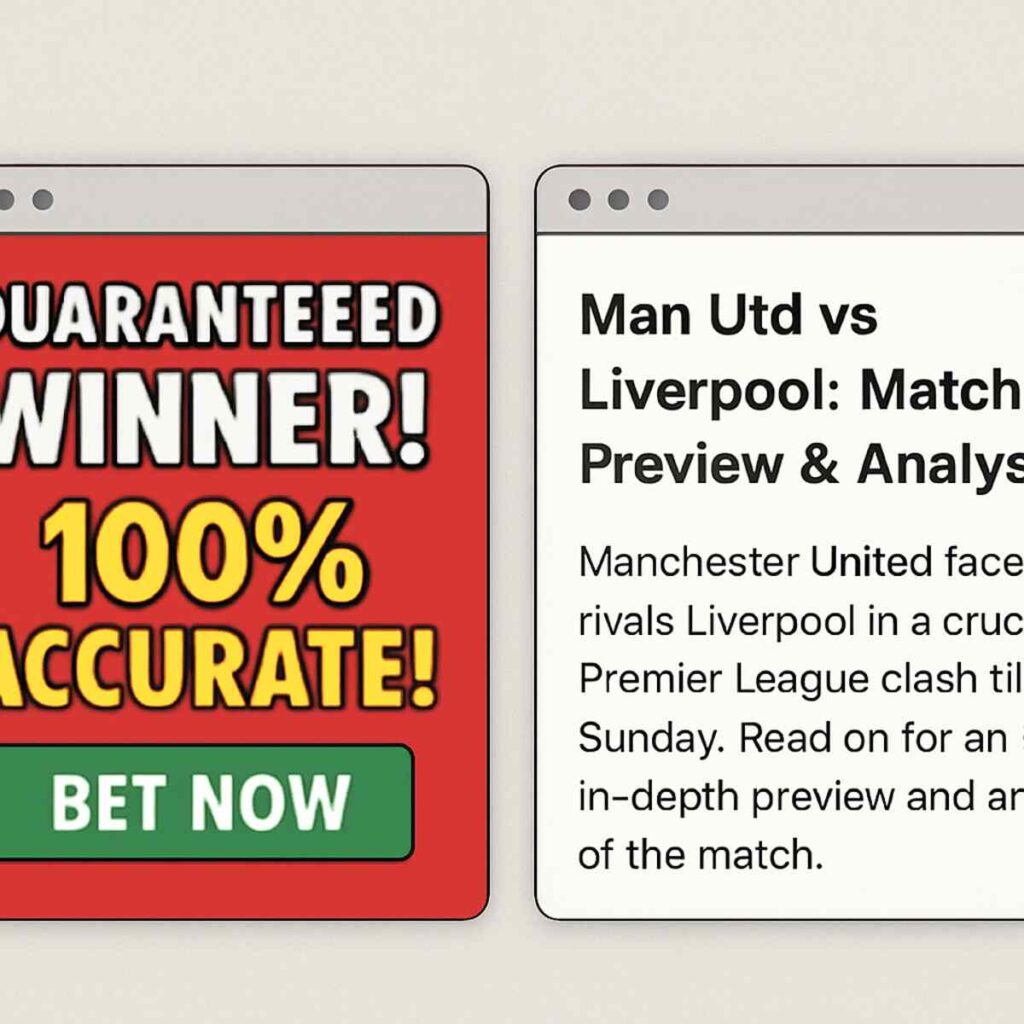
Search for ‘free football predictions,’ and you’ll be flooded with sites promising ‘guaranteed winners’ and ‘100% sure’ tips. It sounds too good to be true because, frankly, it is. Any source that promises a certain victory is selling hype, not help, and can’t be trusted. Receive the Best information about free football predictions.
So, does that mean all predictions are useless? Not at all. A quality football prediction is less like a crystal ball and more like a weather forecast. It might call for an 80% chance of rain, but it doesn’t guarantee you’ll get wet. It simply uses available data—like team form, injuries, and past results—to point toward the most probable outcome.
Simply asking ‘are free betting tips accurate?’ often misses the bigger picture. The true value isn’t in finding a perfect tip but in understanding the logic behind it. Knowing why a team like Manchester City is heavily favored in a match is what transforms you from a casual fan into a more informed observer.
Unraveling these football prediction myths is the first step toward using them wisely. This guide explains how experts make their educated guesses, how to spot trustworthy analysis, and how to use that knowledge to deepen your enjoyment of the beautiful game—all without falling for the empty promises.
The 3 Core Ingredients of Any Football Prediction
Ever wonder how some predictions seem to nail a game’s outcome? It’s not a crystal ball, but a simple recipe. Any solid football analysis starts by weighing three powerful factors. Understanding these will help you spot a logical prediction and separate it from a wild guess.
First up is “team form”—a simple way of asking, “How have they played lately?” A team on a five-game winning streak is confident and their tactics are working. In contrast, a team that hasn’t scored in three matches feels the pressure. Form is often the biggest clue to an upcoming performance.
Then there’s the “home-field advantage.” It’s a real phenomenon. Teams are more comfortable in their own stadium, supported by their fans and without the fatigue of travel. This doesn’t guarantee a win, but it gives the home side a consistent edge that can lead to surprising results against stronger visitors.
Finally, player availability can turn a game on its head. Is a team’s star striker injured, or their best defender suspended? The absence of one key individual can disrupt a team’s entire plan. Experts don’t just see who is playing, but also who isn’t, to truly weigh how these different ingredients might combine on match day.
How Experts Turn Simple Stats into a Smart Prediction
Knowing the three core ingredients is a great start, but a final score of “1-0” doesn’t tell the whole story. Was it a dominant performance, or did the winning team get lucky with a single shot against an opponent who missed five easy chances? Real expert analysis begins by looking for the context behind the result.
An expert asks questions that numbers alone can’t answer. For example, a team that loses 1-0 but creates lots of great scoring opportunities is often in a much better position than a team that wins 1-0 thanks to a fluky own-goal. The first team has a solid process but was unlucky; the second had a lucky outcome but a poor process. Smart analysis always favors the team with the better underlying process.
A student who gets an “A” by guessing on a test isn’t likely to repeat it. An expert wants to find the student who studied hard, because their success is repeatable. In football, they look for teams that consistently play well and create chances, knowing that over the long run, their good performance will lead to good results.
This search for reliable patterns is what separates a thoughtful prediction from a blind guess. It’s about understanding which teams are truly playing well and which are just riding a wave of good fortune. Recognizing this difference is crucial, because many unreliable tipsters will only ever show you the final score, not the story behind it.
The 5-Second Test to Instantly Spot an Unreliable Tipster
A thoughtful prediction looks at the story behind the score. But when you search online for tips, you’re usually met with flashing banners and wild promises, not careful analysis. So, how can you separate the helpful experts from the pure hype in just a few seconds?
Here’s the single biggest rule: if a site promises a “guaranteed win,” a “fixed match,” or a “100% sure tip,” close the tab immediately. Football is famously unpredictable; that’s why we love it. Anyone claiming to have a crystal ball isn’t giving you a prediction—they’re running a scam. If they truly knew the outcome of a match for certain, they would be quiet billionaires, not selling tips online.
Beyond that golden rule, most unreliable tipsters share the same bad habits. You can use this quick checklist to instantly judge whether a source is worth your time.
Red Flag Checklist:
- Promises “Guaranteed” or “Fixed” matches.
- Asks for money for “100% sure tips.”
- Provides a tip with zero explanation or reasoning.
- Hides or deletes their past losing predictions.
Trustworthy sources do the opposite. They offer analysis, explaining why they favor one team over another by discussing form, injuries, or tactics. Crucially, they aren’t afraid to show their history—wins and losses included—because they know predictions are about probability, not certainty.
What Do ‘1X2’ and ‘Over/Under’ Actually Mean?
Once you move past the hype, you’ll notice that good prediction sites use a kind of shorthand, like ‘1X2’ or ‘Over/Under 2.5 Goals’. This might look like complicated code, but it’s a very simple way to categorize different types of predictions. Understanding these two formats will let you decode the vast majority of tips you find online.
The most common option you’ll see is the 1X2 market. This is just a universal way to predict the final result of the match.
- 1 = The Home team wins.
- X = The match ends in a Draw.
- 2 = The Away team wins.
Another popular choice focuses on the total number of goals, known as the Over/Under market. Most tips use the ‘Over/Under 2.5’ line. The ‘.5’ is used to ensure there is always a clear winner—a match can’t have 2.5 goals. A prediction of ‘Over 2.5 Goals’ means the expert expects a total of three or more goals (e.g., scores like 2-1, 3-0, or 2-2). An ‘Under 2.5’ tip means they expect two or fewer goals.
These different prediction categories are simply called “markets.” Each one comes with odds that signal how likely an outcome is. You’ll often see a strong favorite with very low odds, but low odds don’t mean ‘guaranteed’ and high odds don’t mean ‘impossible’.
Why Low Odds Don’t Mean ‘Guaranteed’ and High Odds Don’t Mean ‘Impossible’
When you see odds next to a prediction, think of them as a ‘probability price tag’ rather than a solid promise. A team with very low odds—say, a powerhouse like Manchester City playing a team at the bottom of the table—is simply a heavy favorite. The low odds are the bookmaker’s way of saying, “We believe this is the most likely outcome.” Recognizing this difference is a vital first step for anyone interested in football odds: they signal probability, not certainty.
This is where one of the most common prediction mistakes occurs. Seeing a strong favorite with tiny odds can feel like a sure thing, but football is famously unpredictable. A star player could get a red card, the underdog’s goalkeeper might have the game of his life, or a lucky deflection could change the match entirely. The question of are free betting tips accurate often hinges on this reality; even a logically sound prediction for a heavy favorite can lose because a 1-0 upset is always possible.
On the other side of the coin, high odds don’t mean an outcome is impossible—they just signal it would be a big surprise. Every season is filled with these ‘David vs. Goliath’ moments where an underdog triumphs against all expectations. These upsets are exactly why high odds exist: to reward those who correctly predict a shock result. The temptation, of course, is to bundle several of these seemingly “safe” low-odds bets together, but this popular strategy carries its own significant risks.
What is a Football ‘Accumulator’ Tip and Why Is It So Risky?
That temptation to bundle several seemingly “safe” bets together has a name: the accumulator. Often called an “acca,” it’s a single bet that links the outcomes of multiple matches. The catch is simple but brutal: for you to win, every single one of your predictions must be correct. If you pick four teams to win and only three of them do, the entire bet is lost. If even one link in the chain breaks, the whole thing fails.
The appeal of an accumulator is undeniable. Because the odds of each selection multiply together, it can turn a tiny stake into a massive potential payout, which is why they are promoted so heavily. However, this multiplication also applies to risk. Even if you pick four strong favorites, each with a high chance of winning on their own, the combined probability of all four winning is dramatically lower. Adding just one more team makes your bet exponentially harder to land.
Many sites offer free 1×2 tips bundled into exciting-looking accumulators. They are popular because they sell a dream of a big win from a small bet. For the person placing the bet, however, they are incredibly difficult to win consistently. A better approach is finding valuable football betting markets where the odds might be in your favour—a task that becomes almost impossible when you need five, six, or even more results to go your way at once.
For this reason, it’s best to view accumulators as the football betting equivalent of a lottery ticket: a bit of fun for a very small stake, but not a serious strategy for making informed predictions.
What Is ‘Expected Goals (xG)’ and Why Do Experts Keep Talking About It?
Ever watched your team dominate a match, hitting the post and forcing the keeper into incredible saves, only to lose 1-0 to a lucky deflection? The final score says your team lost, but your eyes tell you they were far better on the day. This frustrating gap between performance and result is exactly what ‘Expected Goals’—or xG—was designed to measure.
xG is essentially a score for the quality of a team’s chances, not just the quantity of their shots. Advanced systems analyze thousands of past shots to assign a value to every new attempt based on its location, angle, and type. For instance, a penalty kick is a very high-quality chance and gets a high xG value (around 0.76 xG), while a hopeful shot from 35 yards out gets a very low one (maybe 0.02 xG). At the end of a match, these values are added up to give each team a total xG score.
This simple number can tell a powerful story that the scoreboard misses. If a team loses 1-0 but finished the game with an xG of 2.8, it means they created chances that would typically result in almost three goals. They were likely just unlucky or wasteful in their finishing. By contrast, their opponent might have won with an xG of 0.3, suggesting their goal was a fluke. Understanding expected goals helps you see which team truly controlled the game.
xG is so valuable for making predictions because a team that consistently posts high xG numbers but fails to win is often a team whose luck is about to turn. Their underlying performance is strong, making them a good candidate for future success. This deeper analysis is often what separates basic tips from predictions with a high win rate.
Paid vs. Free Football Tips: Is It Ever Worth Paying?
After learning about deeper analytics like xG, you might wonder if it’s worth paying for expert insights. With countless websites offering free tips, a subscription can seem unnecessary. The value depends entirely on what you’re looking for, and it’s critical to understand the difference between a genuine service and a costly gimmick.
The best free soccer prediction websites are fantastic educational tools. They provide excellent analysis on popular matches, helping you understand the reasoning behind a likely outcome without spending a penny. Think of them as the sports section of a major newspaper; they give you a solid overview of the big stories, perfect for anyone wanting to learn the fundamentals of what makes a team a favorite or an underdog.
A legitimate paid service should operate like a specialized financial report, not a general newspaper. Its value comes from offering something unique that free sources can’t, such as exclusive data on smaller, less-popular leagues or access to complex predictive models that are expensive to run. It’s a tool for specialists, providing a level of depth that goes far beyond what’s needed for a casual fan.
However—and this is a crucial warning—the vast majority of paid “VIP” services fail to meet this standard. Many simply repackage easily accessible information, make bold and unprovable claims, or offer tips that are no better than a coin flip. Paying for a prediction is never a guarantee of quality. In the end, the source of a tip matters less than its credibility.
Your 3-Step Checklist Before Trusting Any Free Football Tip
With countless free tips flooding the internet, you need a quick way to separate thoughtful analysis from the noise. Instead of getting lost in the search for correct score prediction sites, use this simple, three-step mental checklist before trusting any tip.
Before you trust a prediction, run it through these three questions:
- Check the Analysis: Does it explain the ‘why’? A valuable tip will always offer a reason. Does it mention recent form, injuries to key players, or head-to-head history? A prediction without any justification is no better than a coin flip.
- Check the Source: Is it honest and transparent? Look for sites that track their predictions and admit when they get it wrong. Unreliable tipsters use hype words like “guaranteed” and “100% lock,” and they never mention their losses. A credible source is realistic.
- Check Yourself: What is your goal? Be honest. Are you using this tip to better understand the game and make a more educated guess? Or are you chasing a “sure thing” to win money? The right mindset is to use predictions as an educational tool, not a get-rich-quick scheme.
This checklist shifts your focus from finding a guaranteed winner to finding quality insights. By consistently asking these questions, you develop the habit of a smart analyst. This skill not only protects you from bad advice but also makes watching football a much richer experience.
How to Use Predictions to Enjoy Football More, Not Just to Win Bets
You no longer have to take a prediction at face value. Where you once might have seen confusing numbers or bold claims, you now possess the framework to look behind the curtain. You can identify the simple, logical ingredients—like team form and home advantage—that shape an outcome, allowing you to separate thoughtful analysis from empty hype.
The next time you settle in for a a match, try this: before kickoff, make your own quiet prediction. Think about the key players, recent results, and which team has more to play for. The goal isn’t to be right; it’s to practice thinking like an analyst. This simple exercise will help you enjoy football more, transforming you from a passive spectator into an engaged student of the game.
The real victory isn’t a successful bet, but watching a match and understanding the subtle forces at play. While using free football predictions can be a fun part of your fandom, it is crucial to practice responsible betting. Treat it strictly as entertainment with a firm budget, never as a source of income. Seeing the beautiful game with new eyes—that’s the true prize.