


Ever watched footage of the Apollo mission and thought, “Could I do that?” The famous words, “The Eagle has landed,” made it sound so straightforward. Now, an Apollo moon lander game online lets you take the controls and try it for yourself. But be warned: landing on the moon isn’t anything like parking a car. To find more, check on UFA100
Did you crash on your first ten tries? Don’t worry, almost everyone does. Many players assume the game is broken or unfairly difficult, but the truth is much more interesting. The game isn’t cheating; it’s just playing by the real, surprisingly tricky rules of spaceflight physics, where your instincts about how things move will work against you.
The core challenge isn’t about having fast reflexes. Success comes from understanding two key concepts that feel completely backward here on Earth. First, there are no brakes in the vacuum of space. Second, you must fire an engine to slow down. The goal of the lunar lander isn’t just to arrive, but to master this new way of thinking about movement.
This guide is your mission manual for turning frustration into that “aha!” moment of understanding. Forget crashing—you’re about to learn the secrets behind a perfect, gentle touchdown and complete your first successful mission.
First, Where to Play and What You’re Looking At
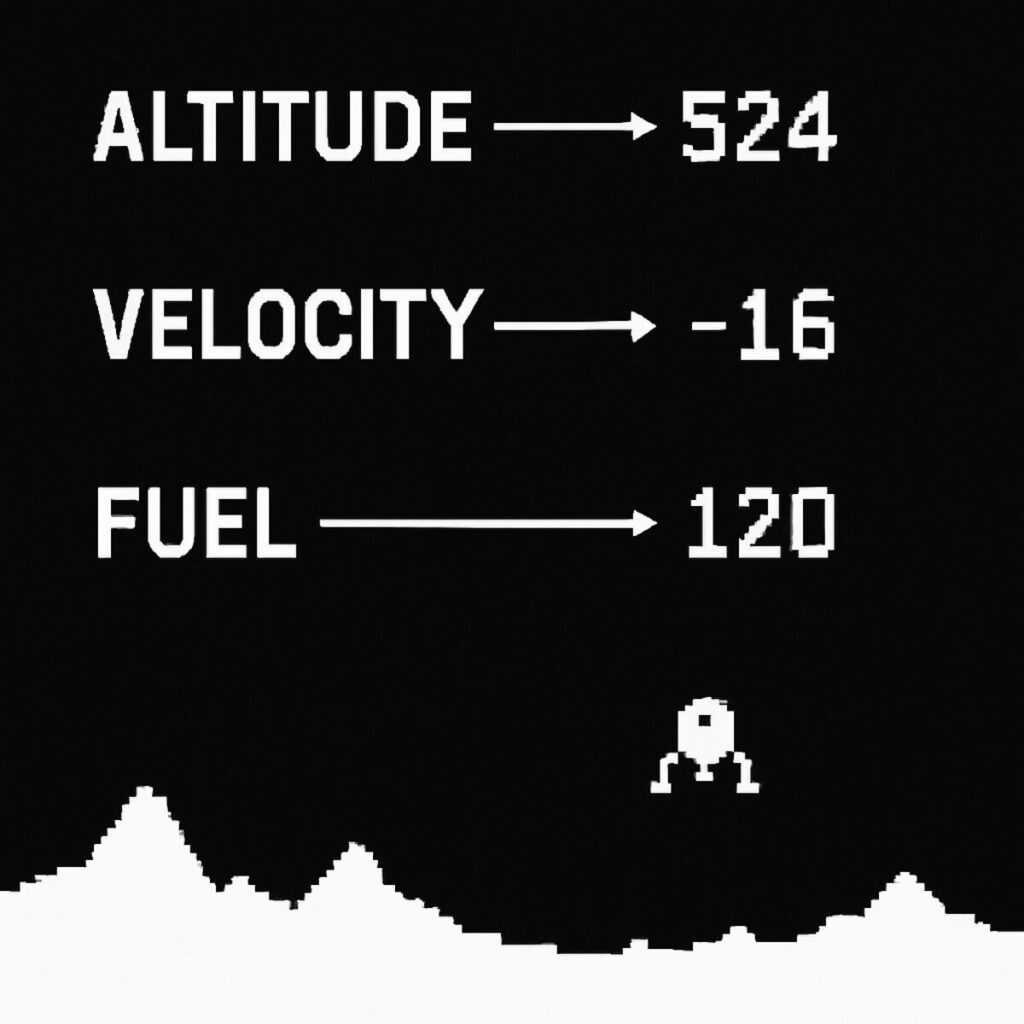
To get your hands on the controls, you don’t need any special software. A quick search for a “free moon landing game no download” will give you several excellent choices that run right in your browser. Before you start your first descent, however, it’s crucial to understand the handful of numbers on your screen. This simple display, often called a Heads-Up Display or HUD, is your lifeline.
Your screen will feature three critical readouts. Altitude is the easiest: it’s simply your height above the lunar surface. Below that, you’ll find your Velocity. This usually shows two speeds: how fast you’re falling vertically and how fast you’re drifting sideways horizontally. The entire challenge is to get both of these speed numbers as close to zero as possible at the exact moment your altitude also hits zero.
Finally, you have your most important readout: the Fuel gauge. Think of this like the gas gauge in your car, but with one major difference—there are no gas stations on the moon. Every single time you fire your engine, even for a tiny nudge, this number goes down. If it hits zero before you land, you’re just a rock falling towards the surface. Now that you know what to watch, let’s cover how you can control these numbers.
Your Basic Controls: How to Steer Your Lunar Module
Controlling your lander is simple, but the way the controls work is probably the opposite of what you expect from a typical game. Pressing the Up Arrow fires your powerful main engine. However, its primary job isn’t to speed you up, but to act as a powerful brake, fighting against gravity to slow your fall toward the moon. Gentle, short bursts are your best friend here; holding the key down will burn through your precious fuel in seconds.
To handle any sideways drift you see on your HUD, you’ll use the Left and Right Arrow keys. These don’t turn your ship like a car’s steering wheel. Instead, they fire small steering jets that give you a gentle nudge. Think of it like being in a canoe and pushing off the side of a dock to move away from it. To stop drifting left, you have to give yourself a little push to the right.
You might have noticed there’s no key to go “down”—gravity takes care of that for you, pulling you constantly toward the surface. Your entire mission is to use these few controls to perfectly balance that fall. This unique challenge leads to the single most important rule of spaceflight.
The #1 Rule of Space: Why Your Lander Has No Brakes
After tapping the arrow keys, you probably noticed something strange. Your lander doesn’t just stop moving when you let go of the controls. If you were drifting left, you’ll keep drifting left. If you were falling, you’ll keep falling. On Earth, friction and air resistance are constantly working to slow things down. In the vacuum of space, those forces are gone, leaving you with a completely new challenge.
Imagine you’re sliding on a massive, perfectly slippery sheet of ice. Once you’re moving, you’ll just keep gliding forever in that same direction until you hit something. You can’t just “decide” to stop; there’s nothing to grab onto and nothing to slow you down. You’d have to do something, like throw a heavy object in the opposite direction, to change your momentum.
Space is exactly like that sheet of ice, but in every direction at once. This core concept, called inertia, is what makes a realistic moon landing physics game so tricky. It’s the main reason so many new pilots find themselves in the dreaded “lunar lander game landing too fast” scenario. Your instincts, trained by a lifetime on Earth where things naturally stop, are working directly against you here.
Your lander has no brakes—at least not in the way a car does. To slow down or stop moving in one direction, you must actively fire an engine to push yourself in the opposite direction. This is the single most important part of any guide to landing on the moon game. So, how do you use an engine that fires “up” to slow your fall “down”? The answer is in the art of firing your engine ‘backwards’.
How to Actually Slow Down: The Art of Firing Your Engine ‘Backwards’
This idea of “braking backwards” is the key to avoiding the all-too-common lunar lander game landing too fast crash. Since gravity is pulling you down, you need to create a force pushing you up. That’s the job of your main engine. To slow your fall, you must point your lander straight up and fire your engine directly toward the lunar surface you’re trying to land on. It feels like putting a car in reverse to slow down while rolling forward, but this is the only way to apply the brakes in the vacuum of space.
Controlling that powerful main engine requires a delicate touch. Your first instinct might be to hold down the thrust key until your vertical speed hits zero, but this will burn through your precious fuel in seconds. The real secret to how to control the lunar module game is to think in short, controlled bursts. Tap the key gently. Let the lander coast. Tap it again. This allows you to make fine-tuned adjustments to your speed without wasting fuel, much like gently tapping the brakes to come to a smooth stop in a car instead of slamming them on.
Of course, a safe landing isn’t just about managing your vertical speed. This same principle of retro thruster control game mechanics applies to your sideways movement. To stop drifting to the right, you must fire your left thruster to push yourself back. To stop drifting left, you fire your right. Juggling these horizontal adjustments while simultaneously managing your descent is the true challenge, and it’s why mastering horizontal drift is so critical.
Why You Keep Crashing Sideways: The Secret to Taming Horizontal Drift
Landing perfectly vertical only to have your lander tip over at the last second is perhaps the most common frustration in any Apollo 11 landing simulation. The culprit is almost always horizontal speed. Even a tiny amount of sideways drift is like trying to step off a moving skateboard—the moment one leg of your lander touches down, its momentum will violently flip the entire craft. A safe landing doesn’t just mean a soft landing; it means a landing with zero sideways motion.
The solution is to think of your landing as two separate missions. Your first priority, long before you get near the ground, is to cancel out all horizontal speed. Watch the horizontal velocity indicator on your screen and use your side thrusters to make it read “0.0.” Fire a quick burst from the right thruster to stop drifting left, and a burst from the left to stop drifting right. This part of the lunar module landing strategy is non-negotiable: kill your sideways drift first, then worry about your altitude.
Once your sideways drift is gone, the entire game simplifies. You’re no longer fighting movement in three directions; you’re just focused on managing a straight, vertical drop. This is the only reliable guide to landing on the moon game players need to avoid that dreaded tip-over. Now you can use those gentle, controlled bursts from your main engine to ease yourself down. Of course, executing this two-step process perfectly requires firing your engines, and every single burst brings your fuel needle closer to empty, beginning the final, agonizing countdown.
The Agonizing Countdown: Making Every Drop of Fuel Last to the End
You’ve mastered the art of stopping that sideways drift, which is a huge step toward a safe landing. But there’s a catch, and it’s staring you in the face: the fuel gauge. Think of your fuel tank not as a resource, but as a strict budget. Every single time you fire an engine—whether it’s the big main engine to slow your fall or the tiny side thrusters for steering—you’re spending from that budget. This turns the whole Tranquility Base landing game into a tense balancing act.
The most common mistake players make is holding down the thrust key for long, continuous burns. While powerful, this is incredibly wasteful. The best lunar lander fuel management tips all boil down to one principle: use short, precise bursts. Tapping the key gently allows you to make small corrections without overshooting your goal, saving precious fuel for the final, critical moments of descent. It’s the difference between flooring the gas pedal between red lights and driving smoothly.
This efficiency is exactly why the two-step lunar module landing strategy works so well. By dealing with your horizontal drift high above the surface, you have more time to make those small, fuel-sipping corrections. If you try to correct your sideways motion and your vertical drop at the same time near the ground, you’ll end up panic-firing all your engines at once, draining your tank in seconds. Handle one problem, then the other.
Ultimately, a successful landing isn’t just one you walk away from; it’s one where you don’t run out of fuel a few feet from the ground. Mastering these short, deliberate engine bursts is the final piece of the puzzle. With an understanding of the physics of movement and the economics of fuel, you’re ready to combine it all into a repeatable process.
Your First Landing Checklist: A 4-Step Guide to a Perfect Touchdown
Knowing the rules of space physics and fuel economy is one thing; executing a plan when the rocky lunar surface is rushing up to meet you is another. It’s easy to panic. The key to overcoming that feeling is to stop improvising and start flying with a repeatable lunar module landing strategy. Instead of reacting to danger, this checklist will help you anticipate each phase of the descent, turning chaos into control.
This simple guide to landing on the moon game breaks the final moments into four manageable steps. Think of it as your pilot’s pre-landing checklist for the Tranquility Base landing game:
- The Approach (High Altitude): First, kill all sideways motion. Your only goal here is to get the horizontal speed (often shown as ‘Vx’) on your display as close to zero as possible. You want to be dropping straight down, not drifting across the landscape.
- The Descent (Mid-Altitude): Now, focus only on your fall. Use short, upward bursts from your main engine to keep your vertical speed (‘Vy’) from building up. Stay calm and aim for a slow, steady rate of descent.
- The Final 100 Meters: This is where precision matters most. Gently control your fall to get your vertical speed under 5 m/s. Use tiny side thrusts to nudge yourself directly over the landing pad.
- The Touchdown: Just before you make contact, give one final, tiny burst from your main engine. You’re aiming for a landing speed under 2 m/s for a soft touchdown that won’t damage the lander.
Following this sequence transforms the experience from a frantic crash into a deliberate, professional procedure. The first time you nail that soft landing with fuel still in the tank, you’ll feel less like a player trying to win and more like a mission commander in complete control.
“The Eagle Has Landed”: Why Your In-Game Stress Was Real for Astronauts
If your heart was pounding as you watched your fuel gauge dip into the red, you’ve felt a tiny fraction of what the Apollo 11 astronauts experienced. That stressful balancing act between speed, position, and fuel wasn’t just a game mechanic; it was the central, terrifying reality of their mission. This Apollo 11 landing simulation doesn’t just teach physics—it teaches empathy for one of the most intense moments in human history.
As Neil Armstrong and Buzz Aldrin made their final descent, their situation was far worse than simply running low on fuel. A series of unexpected computer alarms—the infamous “1202 alarms”—began to flash. The guidance computer was overloaded, forcing the astronauts and Mission Control to make a split-second decision to trust the system or abort the entire landing just moments from the surface.
On top of the blaring alarms, Armstrong looked out his window and saw the autopilot was steering them directly into a crater littered with car-sized boulders. He had to take manual control, flying the lander like a helicopter to search for a safe spot. This maneuver burned through their precious fuel reserves at a frightening rate, something anyone who has over-corrected in the game can understand all too well.
When the Eagle finally touched down on the Sea of Tranquility, it wasn’t with a comfortable margin. It’s estimated they had less than 30 seconds of fuel left. Your struggle in this NASA moon landing simulator is a direct reflection of that reality. Every crash and every near-perfect landing is a tribute to the skill and calm that turned a high-stakes crisis into a giant leap for mankind.
Ready for a New Challenge? Other Moon Lander Games to Explore
Now that you’ve gotten a taste for the challenge, you might be surprised to learn you were playing a piece of video game history. The concept dates all the way back to 1979, when Atari released a beautiful and notoriously difficult arcade cabinet called Lunar Lander. Using crisp vector graphics, it captivated players with the exact same physics-based puzzle: land safely before your fuel runs out. For a fantastic retro experience, you can search online to play the classic Atari lunar lander in your browser.
That classic game sparked a whole category of moon lander game alternatives, each with a different level of difficulty. On one end, you have simple, fast-paced arcade versions that are all about quick reflexes. On the other end of the spectrum, you can find the best lunar lander simulator browser games that are incredibly detailed, forcing you to manage complex systems just like a real astronaut. They offer a much steeper learning curve but provide an amazing sense of accomplishment.
For a fun trip back in time, trying the original Atari version is a great next step. But whether you’re playing that simple classic or a complex modern simulation, the fundamental skills you’ve developed are exactly the same. You haven’t just learned how to beat a game; you’ve gained an intuitive understanding of the physics that governs all movement in space.
From Crashing to ‘Tranquility Base’: What You’ve Truly Mastered
You probably started out crashing. A lot. The controls felt backward, and the lander seemed to have a mind of its own, drifting stubbornly past the landing pad. But now, you understand the secret language of spaceflight. You know that to slow down, you have to fire an engine, and that in the silence of a vacuum, nothing stops unless you command it to.
That shift in thinking is everything. You’ve stopped fighting the physics and started working with them, balancing your precious fuel against the unyielding pull of inertia. This is the core of a real lunar module landing strategy: making calm, deliberate choices to tame your momentum. You’re no longer just a player; you’re a pilot planning your descent.
So, what is the goal of Lunar Lander now that you can survive it? It’s time to aim for mastery. Go back and try for that perfect landing: a touchdown at less than one meter per second with 20% fuel still in the tank. Each attempt isn’t just about getting a high score; it’s about refining your new skill.
The next time you play this Apollo moon lander game online, that flickering screen becomes something more. Every gentle tap of the thrusters, every drop of fuel you conserve, connects you to the monumental challenge faced by the astronauts. You’re not just beating a game; you’re reliving one of humanity’s greatest achievements.