


You’re an hour into a road trip when you hear the dreaded words: “I’m bored.” Or maybe the party conversation has stalled, and everyone is staring at their phones. These moments cry out for a spark of fun, but you didn’t bring a deck of cards or a board game. The good news? The best games aren’t in a box; they’re already in your head, waiting to be played. To find more, check on Soju88 Slot
What if you could turn those dull moments into the most memorable part of the day? Having a mental list of great card game alternatives is like a social superpower, ready to break the ice, connect your family, or simply make waiting feel fun. This has been a go-to strategy for generations, a reliable way to create laughter and connection out of thin air, no props required.
To make it easy, this guide is built like a toolkit, not just a list. We’ve organized the best games to play without cards based on the situation you’re actually in. You’ll find quiet, creative games for two people, quick icebreakers for small groups, and lively party games that can get a whole crowd roaring with laughter.
You don’t need any special skills to become the person who starts the fun. You’ll leave with a go-to solution for any moment, knowing exactly what to play when you are bored with nothing and how to turn any situation into an opportunity for play.
Games You Can Play Right Now, Using Only Your Hands
Sometimes the best games are the ones you already know how to play. Take Rock, Paper, Scissors, the ultimate tool for making small, fair decisions. To make sure everyone is on the same page, the rules are simple: on a count of three, two players each make a hand shape. Rock (a fist) crushes scissors (two fingers), scissors cut paper (a flat hand), and paper covers rock. A tie means you go again. It’s a perfect, no-fuss way to decide who gets the last cookie or has to take out the trash.
For a simple game for two people that involves a little more strategy, try Chopsticks. Each player starts by holding up one index finger on each hand. On your turn, you tap one of your hands on one of your opponent’s. The number of fingers on their hand now becomes the total of what it was, plus what your tapping hand showed. If any hand reaches exactly five fingers, it’s “dead” and goes out of play. The goal is to be the last person with a hand left. You can also use your turn to “split” the fingers between your own two hands to stay in the game longer.
While these hand games are fantastic for quick fun or as icebreaker activities for small groups, they are just the beginning. They prove that you don’t need a box full of pieces to create a moment of connection and competition. But your hands aren’t the only everyday tools you can use. When you’re ready to graduate from hand signals, you’ll find that a simple pen and a napkin can unlock hours of entertainment.
How to Turn a Napkin and Pen into Hours of Fun
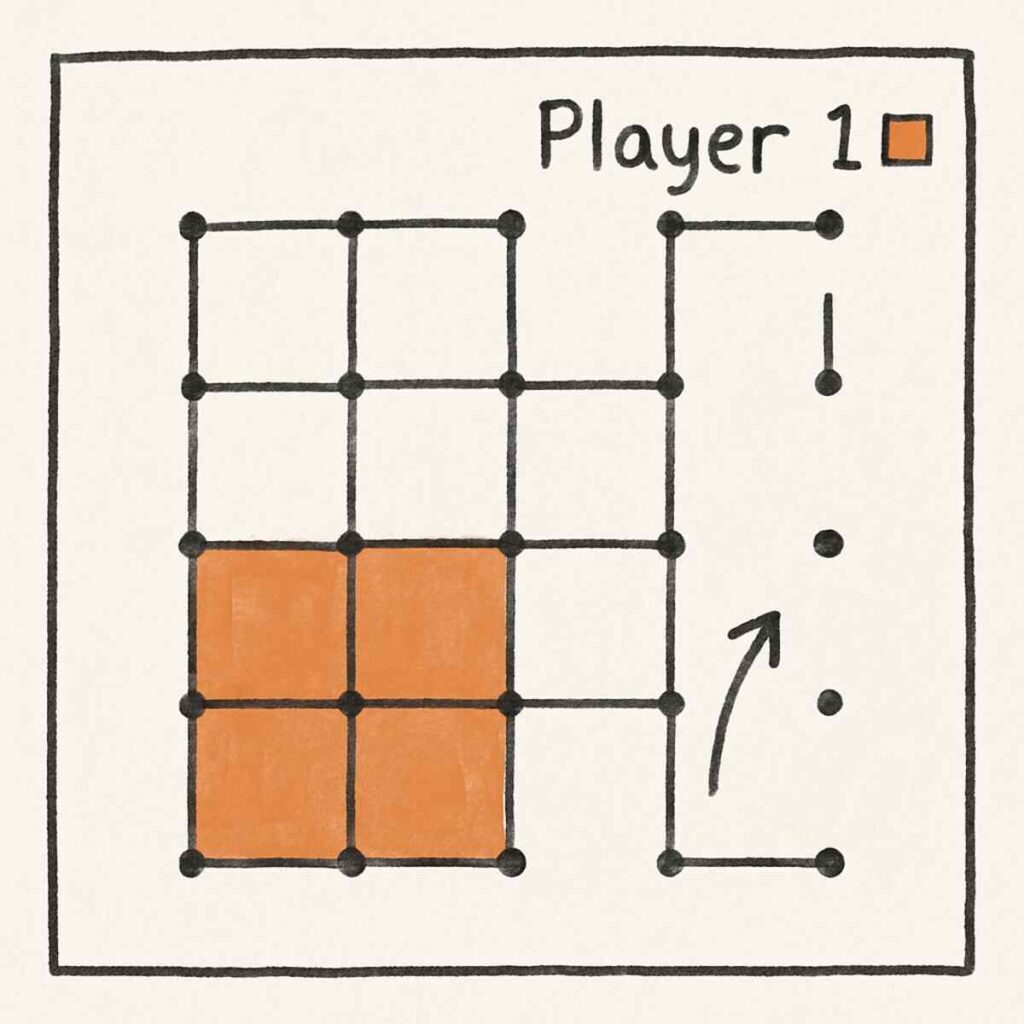
A simple pen and a napkin can unlock a surprising amount of strategic fun. One of the best pen and paper games is Dots and Boxes. Start by drawing a grid of dots, say four across and four down. Players take turns connecting two adjacent dots with a single line. The moment you draw the fourth and final side of a one-by-one square, you claim it by putting your initial inside and, importantly, you get to take another turn.
Patience is the key to winning Dots and Boxes. Avoid drawing the third side of any square for as long as possible. Your goal is to force your opponent to be the one who has to complete that third side, which inevitably creates a long chain of boxes for you to claim on your next turn. Let them hand you the keys to victory while you fill in one square after another. It’s a quiet game of setting traps that is far more clever than it looks.
The list also includes pen and paper classics. Hangman is the perfect two-person game where one player thinks of a word and the other tries to guess it, letter by letter, before a little stick figure is fully drawn. And while you probably know how to play Tic-Tac-Toe, you might be tired of the constant ties. To improve your chances and avoid endless draws, a simple rule of thumb is to always take a corner spot on your first move.
These simple games prove that you don’t need much to create a little competition and connection. They are perfect for quiet moments in a cafe or during a long flight. But when you’re ready to add a little more energy and the luck of the roll to your fun, a pair of dice opens up a whole new world of possibilities.
Simple Dice Games for Two People: Yahtzee vs. Farkle
If you’ve got a handful of dice, you have two of the best card game alternatives for families right at your fingertips: Yahtzee and Farkle. While both involve rolling dice for points, they offer completely different kinds of fun. Understanding their core differences is key to picking the right one for the moment.
Think of Yahtzee as a dice-rolling scavenger hunt. Your goal is to fill out a scorecard with specific combinations, like a “full house” (three of one number, two of another) or a “large straight” (five numbers in a row). Each turn, you get up to three rolls to try and achieve one of the combinations on your list. It’s a game of planning and methodical set collection, where every roll is a step toward checking another box off your list.
Farkle, on the other hand, is a high-energy game of pressing your luck. On your turn, you keep rolling the dice to accumulate points, but there’s a catch. If you ever have a roll where none of your dice score, you “Farkle,” and lose all the points you’ve earned for that round. The central question of the game is always: should you stop and safely bank your points, or risk it all for an even bigger score?
So, comparing Yahtzee vs. Farkle rules, which is the better fit for your group? It all comes down to the kind of energy you want.
- Choose Farkle if: You love risk, drama, and the chance for big comebacks.
- Choose Yahtzee if: You prefer a calmer game of strategy and completing a satisfying checklist.
- Both are great for: A mix of luck and light strategy with two or more players.
While dice bring luck into the mix, some of the best games rely only on your wits and a clever choice of words.
Tired of 20 Questions? Try These Creative Word Guessing Games
The classic 20 Questions is a solid choice, but sometimes you want a game with more teamwork and creative sparks. The best word guessing games for groups turn a simple “what am I thinking of?” into a memorable, laugh-out-loud event, making them perfect parlor games for a dinner party or a quiet night in.
A fantastic alternative is Contact. One person thinks of a word (like ‘pancake’) and gives everyone the first letter, ‘P.’ Then, a player gives a clue for a different P-word, asking, “Is it a baby pig?” If another player gets that they mean ‘piglet,’ both shout ‘Contact!’ and say it together. This forces the original person to reveal the next letter of their word. It’s a clever game of syncing up with other players to force the answer out.
For even more escalating fun, try Fishbowl. Everyone writes a few nouns on slips of paper and puts them in a bowl. You play three rounds using the same words. Round one: Describe the word. Round two: act it out with charades. Round three: use only a single-word clue. Because you’re reusing the words, the game builds on inside jokes and gets funnier with each pass, becoming a hilarious race against the clock.
What makes these 20 questions game variations so special is that they’re less about winning and more about connecting. You build a shared language through a clever clue or a frantic gesture, and the real prize is the funny story you’ll tell later. This focus on physical comedy is at the very heart of another all-time classic.
How to Play Charades and Actually Have Fun
This focus on physical comedy is at the heart of the reigning champion of party games: Charades. The game is a classic because it guarantees laughter, but it can quickly stall when players get frustrated trying to communicate the basics. Establishing a few ground rules and universal signals ahead of time is the secret to turning frantic waving into a clear message, making it one of the best parlor games for a dinner party.
To get everyone on the same page, agree on these five essential hand signals before you start. This simple step makes the game flow a hundred times better.
- Movie: Pretend to crank an old-timey camera.
- Book: Open your hands together like a book.
- Song: Pretend to sing into a microphone.
- Number of Words: Hold up that many fingers.
- Sounds Like: Cup your hand to your ear, then point at a word you’ve acted out.
For the best charades rules and ideas, stick to prompts everyone has a chance of guessing—think blockbuster movies like Jaws, famous songs, or simple actions like “tying your shoes.” To add a competitive spark, split into two teams and use a phone timer. Each correct guess within 60 seconds earns one point. This focus on quick-thinking performance is a great warm-up for games that rely even more on pure imagination.
Easy Improv Games That Don’t Require You to Be ‘Funny’
The word “improv” can make people nervous, bringing to mind slick comedians on a stage. But the best improv games aren’t about landing a punchline; they’re about collaborative storytelling where the fun comes from building something unexpected together. These icebreaker activities for small groups work because there’s no pressure to be clever—only a willingness to participate.
A perfect, zero-pressure starting point is One-Word Story. Players sit or stand in a circle and tell a story together, but each person can only contribute a single word at a time. The first person might say “Once,” the next “upon,” the next “a,” and so on. The story will inevitably twist in hilarious, nonsensical directions (“…the giant banana decided to bake a cake”), and the only skill required is listening to the person before you.
For something a bit more active, try Party Quirks. One person, the “host,” leaves the room while everyone else decides on a strange personality quirk (e.g., “thinks they are a secret agent,” “is allergic to the color blue”). The host returns to the “party” and must figure out everyone’s secret identity simply by talking to them. It’s a game of silly characters, not jokes, making it one of the most fun party games for a group that’s ready to be a little goofy.
The secret to both games is simple: your only job is to accept what other people create and add to it. You don’t have to invent a funny character from thin air, you just have to react to one. This idea of stepping into a role, even a silly one, is also central to games of social deduction, where hiding your secret identity is the entire point.
How to Run a Game of Mafia: A Step-by-Step Guide for the Moderator
Taking the idea of a secret role to the next level, Mafia (or Werewolf) is a classic game of deception and deduction that requires nothing but a group of people. One person acts as a neutral Moderator, guiding the game, while everyone else becomes part of a dramatic struggle for a village’s soul. The game has two secret teams: a small group of Mafia who know each other’s identities, and a larger group of innocent Villagers who are left in the dark. The Villagers win if they can identify and vote out all the Mafia members; the Mafia win when they outnumber the Villagers.
At the start of the game, the Moderator secretly assigns a role to each player by tapping them on the shoulder or showing them a hidden signal. Most players will be Villagers, whose only power is their voice and their vote. Because the Villagers have no information, they must rely on careful observation and social reads to uncover the truth, making this one of the most engaging icebreaker activities for small groups. The tension comes from the fact that anyone, even the most convincing person, could be lying.
To balance the game, a couple of Villagers get special abilities. The Doctor gets to secretly choose one person to save each night. If the Mafia target that person, the Doctor’s protection means they survive. The Detective can secretly point to one person each night and the Moderator will give them a thumbs-up (Mafia) or thumbs-down (Villager) to reveal their identity. These roles add a powerful layer of strategy for the village team.
The game unfolds in two repeating phases: Night and Day. During the Night, the Moderator has everyone close their eyes. They then ask the Mafia to silently open their eyes and agree on one person to eliminate. After, the Doctor and Detective get a turn to secretly use their powers. When Day comes, everyone “wakes up.” The Moderator dramatically reveals who was eliminated overnight, and that player is now out of the game. The remaining players then debate, accuse, and vote on who they think is in the Mafia. Whoever receives the most votes is also eliminated.
Ultimately, a great game of Mafia depends on the Moderator. Your job isn’t to play, but to be the storyteller and rule-keeper, ensuring the Night phase runs secretly and the Day phase is full of lively discussion. It’s one of the best parlor games for a dinner party because it transforms your group into a cast of suspicious characters. For those seeking card game alternatives that create memorable moments of betrayal and triumph, Mafia is an absolute must-try.
Road Trip Games That Actually Beat Boredom
The dreaded “Are we there yet?” can be silenced with the right activity. When you’re miles from your destination, a good game is the perfect way to pass the time, and you don’t need a single prop to do it. These road trip games that don’t need equipment turn a long drive into a shared adventure, proving that the journey can be just as fun as the destination.
A true classic for a reason, the Alphabet Game turns the passing scenery into a competitive hunt. Each person in the car works their way through the alphabet, from A to Z, by spotting letters on road signs, license plates, or storefronts. Players must find the letters in order; you can’t claim a ‘B’ until you’ve found an ‘A’. It’s a simple race to see who can find a ‘Z’ first, transforming a boring highway into a visual puzzle.
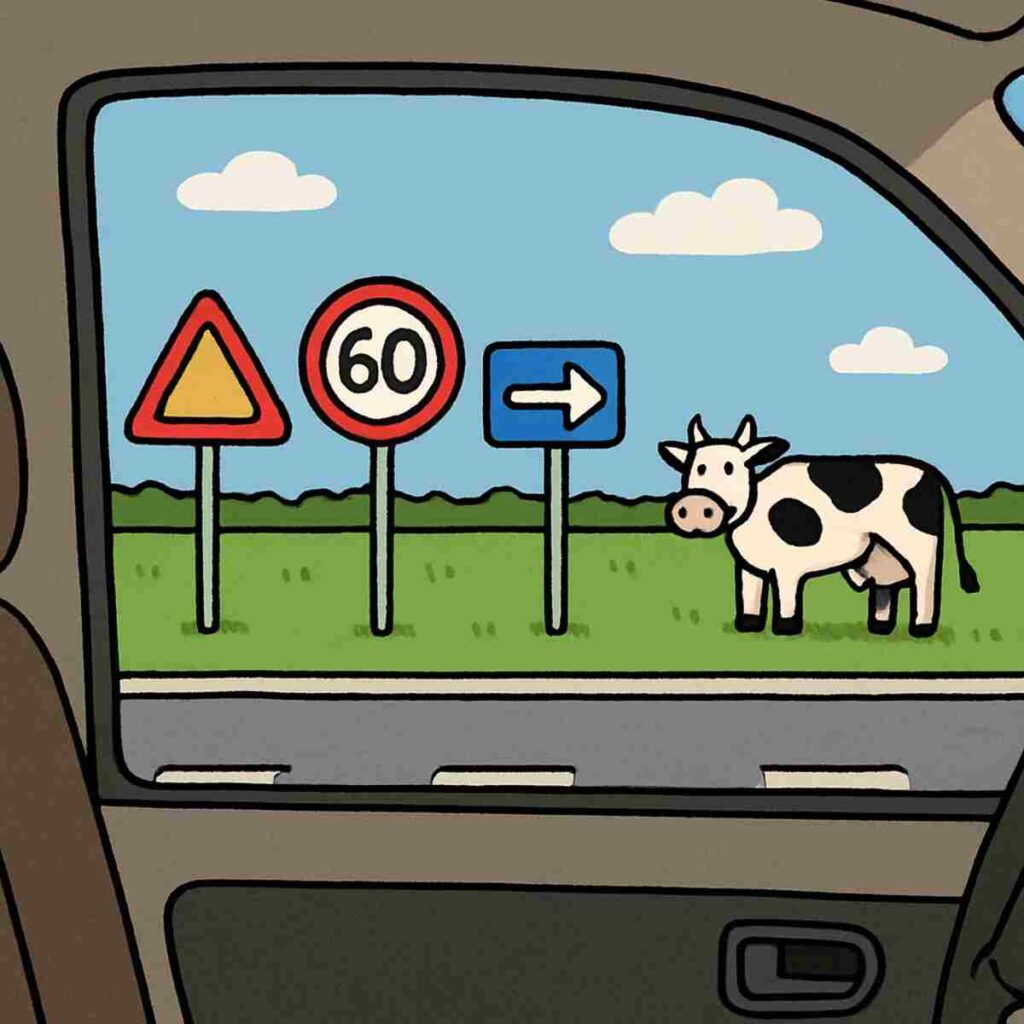
For something a little more chaotic, try Cows on My Side. The rules are simple: if you see a cow on your side of the car, you shout, “Cows on my side!” and score a point for each one. The crucial twist? If you pass a cemetery on your side, you must yell, “Ghost cow!” and all your points are wiped out. It’s a silly but surprisingly intense game that never fails to get a laugh.
If you’d rather build a story together, Fortunately/Unfortunately is one of the best card game alternatives for families. One person starts with an optimistic sentence, like, “Fortunately, we discovered a hidden spaceship.” The next person adds a pessimistic turn: “Unfortunately, it was out of gas.” Players alternate, weaving a wild narrative one sentence at a time. It’s a fantastic game for when you have nothing but your own imagination.
Your New ‘Play Anywhere’ Toolkit: What to Try First
Where a stalled conversation or a long wait in line once felt like a dead end, you now see an opportunity. You’re equipped with a mental toolkit of engaging games for any situation. If you have just one friend and a napkin, you can start a game of Dots and Boxes. If you have a lively group, you have the know-how to lead one of many fun party games. You’ve gone from being a passive passenger to the driver of fun.
To put this new knowledge into practice, challenge yourself to suggest just one game this week. When you introduce it, remember the most important tip for teaching how to play games without friction: explain the goal first. Simply starting with, “The goal is for our team to guess the secret word,” before diving into rules, ensures everyone feels included and ready to play from the start.
You no longer need a box, a board, or a deck of cards to create a memorable moment—that power is already in your head, ready to be shared. So, which game will you suggest first?