


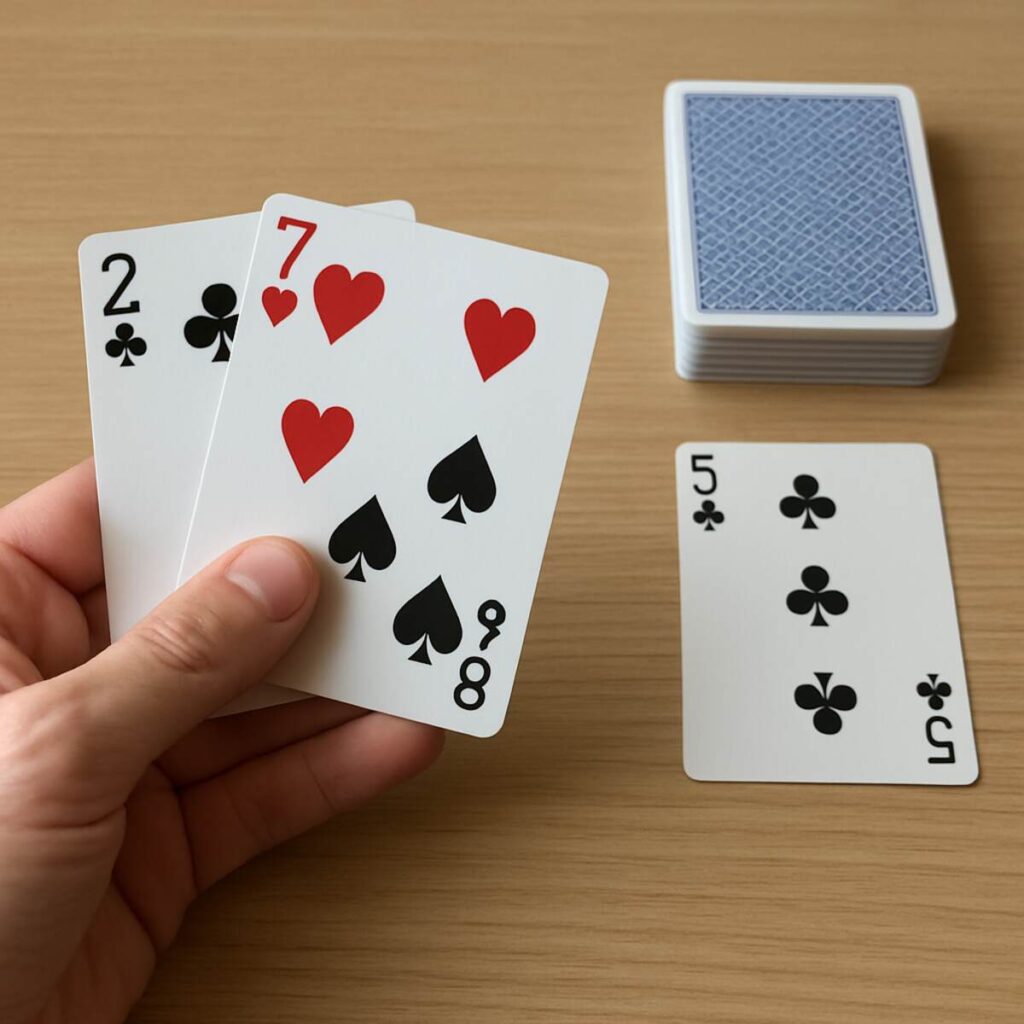
Ever been at a party when someone pulls out a deck of cards for a game called ’99’? Everyone seems to know the rules, leaving you on the sidelines. The good news is, in about five minutes, this guide will teach you everything you need to confidently join the next hand. To find more, check on แทงมวย
The ninety-nine game isn’t about winning in a traditional sense; it’s a simple and addictive game of survival. Your entire focus boils down to one critical objective: do not be the player who pushes the score over 99. Common knowledge among players is that it’s less about having the best cards and more about not being forced into making the final, game-losing play.
Throughout each round, players take turns adding a card’s value to a running total that is announced to the group. Understanding how to play the card game 99 is that straightforward. Once you grasp this single goal of keeping the shared score under the limit, you have already mastered half the game.
What You Need to Start a Game of 99
One of the best parts about 99 is that you don’t need any special equipment to play. If you have a regular deck of playing cards and a few friends, you’re already most of the way there. The game is designed to be quick to set up and easy to start.
To get a game going, you’ll just need these three things:
- A standard 52-card deck. (No jokers necessary.)
- Three “lives” for each player. These act as scorekeepers. Pennies, bottle caps, or even torn pieces of paper work perfectly.
- 3 or more players.
While you can technically play 99 with two players, the game is much more fun and unpredictable with a group of three or more. Once everyone has their three “lives” sitting in front of them, you’re ready to deal the cards.
How to Deal and Start the Game
To get started, someone needs to be the dealer. You can pick anyone to deal the first hand; a common way is to have the person who suggested the game deal first. The dealer shuffles the deck and gives three cards, face down, to every player, including themselves. Everyone can look at their own cards but should keep them secret from the other players.
After the cards are dealt, the dealer places the rest of the deck face down in the center of the table. This stack is the draw pile, which is where you’ll get new cards from during the game. Right next to it, you’ll create a discard pile as you play. For now, this space is empty. The very first player will be the one to start it.
Play officially begins with the person sitting to the dealer’s left and continues clockwise around the table. The game is now set up and ready for the first move. From here on out, the goal is to play a card from your hand without being the one who pushes the group’s total score over 99.
What to Do On Your Turn: The Basic Play
When it’s your turn, your actions revolve around a shared score called the running total. Think of this as a public counter that starts at zero and goes up with each card played. Your goal is to add to this total without being the one to make it go over 99.
Every turn follows the same four simple steps:
- Play one card from your hand, placing it face-up on the discard pile.
- Add its value to the current running total.
- Say the new total out loud for everyone to hear.
- Draw one card from the draw pile so you have three cards again.
For most number cards (2, 3, 5, 6, 7, 8), their value is simply the number on the card. For example, if it’s the very first turn, the running total is zero. If you play an 8, you would say, “Eight!” The next player now has to play on a total of 8. If they then play a 6, they add it to your 8 and announce, “Fourteen!”
This simple loop of playing, adding, announcing, and drawing continues around the table, making the running total climb higher and higher. But the real strategy lies with the special cards, which have game-changing powers that can save you when the score gets dangerously close to 99.
The Meaning of Special Cards in 99
Just adding numbers is simple enough when the total is low, but what happens when the count hits 95 and all you have are high cards? This is where the special cards in 99 become your most valuable assets. Unlike the other number cards, the Ace, 4, 9, 10, Jack, Queen, and King all have unique powers that can save you from going bust. Holding onto one of these is like having a secret weapon, giving you a powerful way to control the game and stay safe when the pressure is on.
These special cards manipulate the score, change the direction of play, or affect the game’s flow by skipping players. Understanding their powers is the final step to mastering the rules.
How to Use Cards That Change the Score: Ace and 10
Two of the most helpful cards you can hold are the Ace and the 10. Instead of having a single, fixed value, they give you a choice, which is exactly what you need when the total is climbing dangerously close to that 99-point limit.
The Ace offers simple flexibility. When you play it, you choose whether it adds 1 or 11 to the running total. For example, if the count is 92, you can safely play your Ace as a 1 to make the total 93. If the total is much lower, say 40, you could play it as an 11 to bring the total to 51. You just have to announce your choice out loud for everyone to hear.
Even more powerful is the 10, which gives you the unique ability to send the count backward. When you play a 10, you can choose to either add 10 points or subtract 10 points from the total. Imagine the count is a terrifying 98. Playing a 10 lets you declare, “Subtract 10, the new total is 88!” This power is a complete game-changer and reveals that the cards in 99 are tools to keep you alive.
Both the Ace and the 10 provide crucial breathing room by giving you control over the number itself. They are lifesavers in tight spots. But other special cards don’t just change the score—they change the very rules of the game, like who plays next.
How to Use Cards That Change the Game: 4, 9, and King
While Aces and 10s give you control over the score, other special cards in 99 mess with the flow of the game itself. These are the cards you play not just to save yourself, but to put pressure on your opponents. Mastering them is key to moving beyond simple survival and starting to play with a bit of mischief.
The three most disruptive cards are the Four, the Nine, and the King. Here’s what each one does:
- Four (4): The 99 card game reverse card. It reverses the direction of play and still adds 4 points to the total.
- Nine (9): A “pass.” The total does not change, and play moves to the next person. It’s a sigh of relief when you have no other safe moves.
- King (K): The ultimate power play. No matter what the count is, playing a King instantly sets the total to 99. This is a high-risk, high-reward move that can immediately knock out the next player.

With these cards, you can do more than just add numbers—you can skip a player who you think is in trouble, reverse the order to target someone else, or force the count to its absolute limit. You may have noticed we haven’t mentioned Jacks or Queens yet; they have their own unique and helpful roles to play.
What About Jacks and Queens?
After learning about all the tricks that Kings, Nines, and Fours can pull, it’s natural to wonder what the Jacks and Queens do. The answer is refreshingly simple: they are worth 10 points. That’s it. No special powers, no choices to make. When you play a Jack or a Queen, you just add 10 to the running total.
Think of them as just another 10-point card, but without the special ability to subtract from the total. This is a crucial rule for beginners to remember, as it prevents the common mistake of saving a Jack or Queen for a special move that doesn’t exist. Now that you know what every card does, you’re ready for the most important moment: what happens when you can’t make a legal play.
What Happens When You Go Over 99?
Sooner or later, it happens: the count is 98, and the only cards in your hand are a 5 and a Queen. Since you can’t play a card without pushing the total over 99, you have to declare that you’re out. This is what happens if you go over 99—you lose the round. At this point, you toss one of your three “lives” (pennies, poker chips, or any token will do) into the middle of the table.
Once you’re out, you set your cards aside and wait. The other players continue the round, with the total resetting to what it was before your turn. They keep playing until only one person is left, who is declared the winner of that single round. This method of elimination is how you score in the card game ninety-nine; you’re not trying to get points, you’re trying not to lose your tokens.
When the round is over, the magic happens again. The dealer collects all the cards, shuffles the full deck, and deals three new cards to everyone—even the players who just lost a life. The count resets to zero, and the next round begins. This continues until only one person has any tokens left. That last player standing is the overall winner! To see these rules in action, let’s walk through a sample round.
Let’s Play a Sample Round: See the Rules in Action
Theory is one thing, but seeing the game unfold is the best way to understand it. Let’s imagine a three-player game with Alex, Ben, and Carla. Everyone has three cards and three tokens. The count starts at zero.
Alex kicks things off by playing a 7 of hearts. He places it on the discard pile, announces, “The total is 7,” and draws a new card. Ben is next. He plays a 6 of clubs, adding it to the total. “The total is 13,” he says, before drawing his replacement card. So far, the game is a simple exercise in addition.
Now it’s Carla’s turn. The count is 13. Looking at her hand, she decides to play a 10 of spades. Instead of adding, she uses its special power. “Subtract 10, the new total is 3!” she declares. She draws a card, and play passes back to Alex. This simple move completely changed the momentum.
After a few more turns, the total has climbed all the way to 95, and the pressure is on. It’s Ben’s turn, and his only safe card is a 4 of diamonds. He plays it, says, “Total is 99, and I’m reversing the direction of play!” Play would have gone to Carla, but the reverse sends it back to Alex. This is a perfect example of using a card not just for its value but for its strategic effect.
Stuck with the turn he didn’t expect, Alex looks at his hand: a King and an 8. He can’t play the 8 without going over. He could play the King to keep the total at 99, but that would just pass the problem to Carla. Instead, let’s say he has no special cards and must play the 8. “The total is 107, I’m out,” he says, tossing one of his tokens into the pot. Because only two players are left, the round ends. Everyone shuffles up and gets ready for the next round, but Alex is now one step closer to elimination.
Simple Tips to Help You Survive Your First Game
Now that you understand the rules, you’re ready to play them smartly. You don’t need a complex strategy. The key to surviving your first few rounds is simply understanding that some cards are more valuable than others, especially when the pressure is on.
As the running total creeps into the 80s or 90s, your special cards become lifesavers. It might be tempting to play a 9 (Pass) early on, but try to hold onto it. When the count is 98 and it’s your turn, that 9 lets you safely pass play without adding a thing. Similarly, a 4 (Reverse) is a powerful tool to push a difficult turn back onto the person who just played, getting you out of a tight spot.
Some cards are best used to put others in trouble. If you have a 10, using it to subtract and lower the count can be a great defensive move that gives you breathing room. The King, however, is pure offense. Playing a King to make the total 99 is rarely about saving yourself—it’s about forcing the next player into an impossible situation. These simple strategy tips are about knowing when to defend and when to attack.
Ultimately, the best way to play the 99 card game is to watch the count and think about what your card will do to the next person. It’s a simple game of pushing risk around the table until someone can’t handle it.
How Is 99 Different From UNO?
While both games use special cards like “Reverse” to cause chaos, the core objectives are completely opposite. In UNO, your goal is to get rid of all your cards. Success means having an empty hand. In the 99 card game, the goal is survival. You want to stay in the game as long as possible by forcing other players to be the one who pushes the score past 99.
The fundamental turn-by-turn action is also entirely different. A turn in UNO is about matching—you must match the color, number, or symbol of the card on the discard pile. The rules for 99, however, are all about simple math. You aren’t matching anything; instead, you play a card from your hand and add its value to a running total that everyone shares.
The final key distinction is that the ninety-nine game has no “call UNO!” moment. A player is simply knocked out of a round when they cannot play a card from their hand without making the total exceed 99. There’s no penalty for not announcing anything, just the quiet loss of a life. So, although they might feel related, the experience of 99 vs. UNO is unique. One is a race to empty your hand, while the other is a tense battle of attrition.
99 Card Game Cheatsheet & Final Thoughts
You now know the single most important goal, the flow of each turn, and the power of every special card. Before you play, here’s a quick summary to keep handy:
- Ace: Adds 1 or 11 points (your choice).
- 4: Adds 4 points and reverses the direction of play.
- 9: Pass. The total does not change.
- 10: Adds 10 or subtracts 10 points (your choice).
- King: Instantly sets the total to 99.
- Jack & Queen: Worth 10 points.
- 2, 3, 5, 6, 7, 8: Worth their face value.
You’re no longer on the sidelines; you’re ready to deal in. Your first game isn’t about winning; it’s about seeing the rules click into place. So gather some friends, deal the cards, and just focus on the rhythm of playing a card and calling out the new total. With each hand you play, the functions of the cards will become second nature. Soon, you won’t just be playing the game—you’ll be the one teaching it, turning any quiet evening into a table full of laughter and suspense, all centered on that one magic number.